Showing posts with label Chris Paton. Show all posts

Thursday, 23 January 2020

Pre-order my next book Tracing Your Scottish Family History on the Internet

My next book, Tracing Your Scottish Family History on the Internet, is now available to pre-order from publisher Pen and Sword www.pen-and-sword.co.uk/Tracing-Your-Scottish-Family-History-on-the-Internet-Paperback/p/17717. The book is scheduled for publication on April 30th 2020.


Here's the blurb!

Scotland is a land with a proud and centuries long history that far pre-dates its membership of Great Britain and the United Kingdom. Today in the 21st century it is also a land that has done much to make its historical records accessible, to help those with Caledonian ancestry trace their roots back to earlier times and a world long past.

In Tracing Scottish Family History on the Internet, Chris Paton expertly guides the family historian through the many Scottish records offerings available, but also cautions the reader that not every record is online, providing detailed advice on how to use web based finding aids to locate further material across the country and beyond. He also examines social networking and the many DNA platforms that are currently further revolutionising online Scottish research.

From the Scottish Government websites offering access to our most important national records, to the holdings of local archives, libraries, family history societies, and online vendors, Chris Paton takes the reader across Scotland, from the Highlands and Islands, through the Central Belt and the Lowlands, and across the diaspora, to explore the various flavours of Scottishness that have bound us together as a nation for so long.


As with all my books, I hope it proves to be useful!

Don't forget also that Tracing Your Scottish Ancestry Through Church and State Records is also now available at https://www.pen-and-sword.co.uk/Tracing-Your-Scottish-Ancestry-through-Church-and-State-Records-Paperback/p/16848 - I've just noticed that it is also now available to purchase in the United States on Amazon.com.


Chris

Order Tracing Your Irish Family History on the Internet (2nd ed) at https://www.pen-and-sword.co.uk/Tracing-Your-Irish-Family-History-on-the-Internet-Paperback/p/16483. and Tracing Your Scottish Ancestry Through Church and State Records at https://www.pen-and-sword.co.uk/Tracing-Your-Scottish-Ancestry-through-Church-and-State-Records-Paperback/p/16848. Further news published daily on The GENES Blog Facebook page, and on Twitter @genesblog.

Tuesday, 3 December 2019

Christmas is coming, where's the goose...?!

If you are short of a present or two for your genealogy obsessed relatives (or your genealogy obsessed self!), a quick plug for my latest two family history books from my publisher Pen and Sword (www.pen-and-sword.co.uk), which you still have time to order and obtain before Christmas Day!

Tracing Your Scottish Ancestry Through Church and State Records
https://www.pen-and-sword.co.uk/Tracing-Your-Scottish-Ancestry-through-Church-and-State-Records-Paperback/p/16848
£11.99 (plus p&p)

Despite its Union with England and Wales in 1707, Scotland remained virtually independent from its partners in many ways, retaining its own legal system, its own state church, and its own education system.

In Tracing Scottish Ancestry Through Church and State Records, genealogist Chris Paton examines the most common records used by family historians in Scotland, ranging from the vital records kept by the state and the various churches, the decennial censuses, tax records, registers of land ownership and inheritance, and records of law and order.

Through precepts of clare constat and ultimus haeres records, feudalism and udal tenure, to irregular marriages, penny weddings and records of sequestration, Chris Paton expertly explores the unique concepts and language within many Scottish records that are simply not found elsewhere within the British Isles. He details their purpose and the information recorded, the legal basis by which they were created, and where to find them both online and within Scotland's many archives and institutions.


Tracing Your Irish Family History on the Internet (Second Edition)
https://www.pen-and-sword.co.uk/Tracing-Your-Irish-Family-History-on-the-Internet-Paperback/p/16483
£11.99 (plus p&p)

In this, the fully updated second edition of his bestselling guide to researching Irish history using the internet, Chris Paton shows the extraordinary variety of sources that can now be accessed online. Although Ireland has lost many records that would have been of great interest to family historians, he demonstrates that a great deal of information survived and is now easily available to the researcher.

Thanks to the pioneering efforts of the Public Record Office of Northern Ireland, the National Archives of Ireland, organizations such as FindmyPast Ireland, Ancestry.co.uk and RootsIreland and the volunteer genealogical community, an ever-increasing range of Ireland’s historical resources are accessible from afar.

As well as exploring the various categories of records that the family historian can turn to, Chris Paton illustrates their use with fascinating case studies. He fully explores the online records available from both the north and the south from the earliest times to the present day. Many overseas collections are also included, and he looks at social networking in an Irish context where many exciting projects are currently underway.

His book is an essential introduction and source of reference for anyone who is keen to trace their Irish roots.

This latest title in Pen and Sword's most excellent genealogy library is one of the very best I have ever read, with thoroughly practical examples of websites where you can get information from, in many cases for no cost (you'll notice I avoided using the very wrong phrase "for free"!) The websites mentioned have genuinely free information, and they all work. Chris Paton has written a brilliantly useful book - we happen to have Irish ancestry in our family, and will be delving into this information just as soon as we have the time. In the meantime, I urge you to get this book and do the same!

- Books Monthly


And coming soon...

Over the Christmas holidays I will be working on my next two books:

Tracing Your Scottish Family History on the Internet - already written, and now at the proof stage, this title will be published in April 2020 and I hope will complement Tracing Your Scottish Ancestry Through Church and State Records!

Sharing Your Family History on the Internet - I'm still at the keyboard with this one, and will announce more about it in due course!!!!

Chris

Order Tracing Your Irish Family History on the Internet (2nd ed) at https://www.pen-and-sword.co.uk/Tracing-Your-Irish-Family-History-on-the-Internet-Paperback/p/16483. and Tracing Your Scottish Ancestry Through Church and State Records at https://www.pen-and-sword.co.uk/Tracing-Your-Scottish-Ancestry-through-Church-and-State-Records-Paperback/p/16848. Further news published daily on The GENES Blog Facebook page, and on Twitter @genesblog.

Thursday, 21 November 2019

Tracing Your Scottish Ancestry Through Church and State Records - out now!

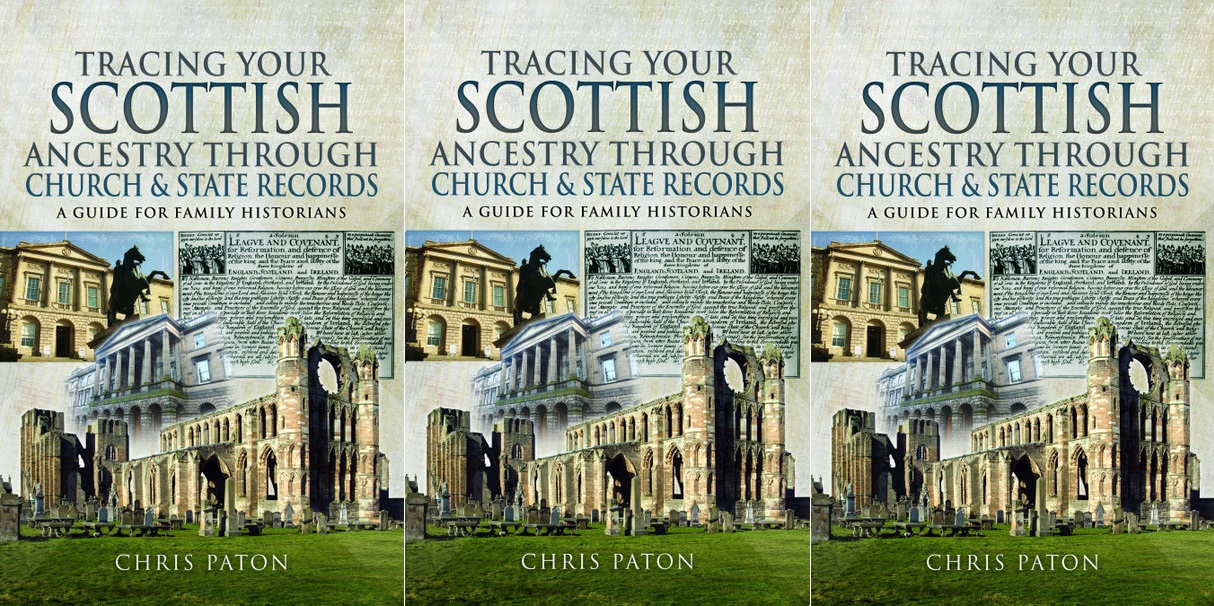
I'm delighted to announce that my latest book from Pen and Sword, Tracing Your Scottish Ancestry Through Church and State Records has now been published and is available to buy via https://www.pen-and-sword.co.uk/Tracing-Your-Scottish-Ancestry-through-Church-and-State-Records-Paperback/p/16848 and other retailers.

Here is the blurb and the contents list:

Tracing Your Scottish Ancestry through Church and State Records: A Guide for Family Historians

Despite its Union with England and Wales in 1707, Scotland remained virtually independent from its partners in many ways, retaining its own legal system, its own state church, and its own education system.

In Tracing Scottish Ancestry Through Church and State Records, genealogist Chris Paton examines the most common records used by family historians in Scotland, ranging from the vital records kept by the state and the various churches, the decennial censuses, tax records, registers of land ownership and inheritance, and records of law and order.

Through precepts of clare constat and ultimus haeres records, feudalism and udal tenure, to irregular marriages, penny weddings and records of sequestration, Chris Paton expertly explores the unique concepts and language within many Scottish records that are simply not found elsewhere within the British Isles. He details their purpose and the information recorded, the legal basis by which they were created, and where to find them both online and within Scotland's many archives and institutions.

Contents

Glossary

Introduction

Chapter 1 – Research Resources
- National Records of Scotland
- ScotlandsPeople Centre
- Court of the Lord Lyon
- National Library of Scotland
- Historic Environment Scotland
- Registers of Scotland
- Scottish Council on Archives
- Scottish Archive Network
- National Register of Archives for Scotland
- FamilySearch Family History Centres
- Scottish Association of Family History Societies
- Commercial websites
- Handwriting
- Languages

Chapter 2 – Civil registration
- Establishment of Civil Registration
- Registration of Births
- Illegitimacy
- Locating Birth Records
- Minor Records of Births
- Stillbirths
- Adoption
- Vaccination
- Locating Vaccination Records
- Marriage
- Registration of Regular Marriages
- Irregular and Civil Marriages
- Locating Marriage Records
- Minor Records of Marriage
- Divorce
- Registration of Deaths
- Locating Death Records
- Minor Records of Death
- Register of Corrected Entries

Chapter 3 – Church of Scotland records
- Background
- Old Parish Registers (OPRs)
- Baptisms
- Naming patterns
- Foundlings
- Stillbirths in parish records
- Missing baptisms
- Marriages
- Marriage customs
- Irregular marriages
- Deaths and Burials
- Finding the records
- Kirk Session records
- Locating Kirk Session Records
- Presbytery, Synod and General Assembly
- Heritors

Chapter 4 – Other churches
- Switching churches
- Finding dissenter records
- Other Church Denominations
- Scottish Episcopal Church
- Locating Episcopal church records
- Roman Catholicism
- Locating the CPRs
- Smaller denominations

Chapter 5 - Where were they?
- Census records
- National Identity Register
- Electoral Registers
- Valuation Rolls
- Burgh assessment rolls
- Poor law records
- Tax records
- Inland Revenue Field Books
- Forfeited estates
- Maps
- The Statistical Accounts of Scotland
- Other gazetteers

Chapter 6 – Land tenure
- Scotland
- Feudalism
- Royal burghs
- Charters
- Instruments of Sasine
- The Registers of Sasines
- Liferents and Trusts
- Registers of Scotland
- Registers of Deeds
- Estate papers
- Tacksmen
- The end of feudalism
- Udal tenure
- Other forms of tenure

Chapter 7 – Inheritance
- Moveable estate
- Testaments
- Calendars of Confirmations and Inventories
- Heritable estate
- The Services of Heirs
- Precepts of Clare Constat
- Trust dispositions and settlements
- Types of Heir
- Ultimus haeres records

Chapter 8 – Law and Order
- Scots Law
- Sheriff Courts
- Privy Council
- Criminal prosecution
- Case Study: The Mount Stewart Murder
- Fatal Accident Enquiries
- Court of Session
- Debt
- Case Study: Matthew Campbell of Waterhaughs
- Bankruptcy
- Case study: John Brownlie MacFarlane
- Commissary Courts
- Franchise and burgh courts
- Trade incorporations
- Justices of the Peace
- Admiralty Court
- Court of the Lord Lyon
- Police and prison records
- Transportation
- Capital punishment

Bibliography / Further Reading

Index


Enjoy!

Chris

Order Tracing Your Irish Family History on the Internet (2nd ed) at https://www.pen-and-sword.co.uk/Tracing-Your-Irish-Family-History-on-the-Internet-Paperback/p/16483. My next Scotland 1750-1850: Beyond the OPRs course starts 4 November 2019 - see https://www.pharostutors.com/details.php?coursenumber=302. Further news published daily on The GENES Blog Facebook page, and on Twitter @genesblog.