Thanks to Pen and Sword for a review copy of an immensely useful DNA book:
Tracing Your Ancestors Using DNA: A Guide for Family Historians
Edited by Graham Holton: Contributions by John Cleary, Michelle Leonard, Iain McDonald, Alasdair F. MacDonald
DNA is the family history tool that took me some time to embrace, and to grow to love. Having started with taking a Y-DNA test over a decade ago, I have had no hits of any significance since then, and so after an initial interest I placed the field to one side and continued to rely on documentation alone. The rise of autosomal DNA testing in recent years, however, utterly transformed my perception of the usefulness of DNA in genealogy, and in many cases has revolutionised and complimented my own research.
There are many useful DNA guide books out there, not least Blaine Bettinger's essential The Family Tree Guide to DNA Testing and Genetic Genealogy, but this new book by some of Scotland's finest genetic genealogists is a real up to date tonic for those trying to get to grips with all aspects of the field. Despite the numerous contributors, it comes across with a consistent voice when conveying knowledge to the reader, a good testament to the editing skills of Graham Holton.
After an introduction from Graham, and then a team effort asking why we should use DNA testing for genealogy, the book gets stuck into an absorbing offering from John Cleary on the ethical and legal aspects of genetic genealogy, citing interesting cases involving confidentiality, such as a recent inheritance case involving the Pringle baronetcy (see http://britishgenes.blogspot.com/2016/06/dna-evidence-resolves-baronetcy.html), and privacy, for example with the controversial use by law enforcement agencies in the USA of DNA databases created by the family history community.
Well known Glasgow based genetic genealogist Michelle Leonard then gets a clear run to explain the basics of all types of DNA tests - Y-DNA, mtDNA, and autosomal & X-DNA - followed by a chapter on autosomal (atDNA) tests. In this she may have helped to resolve a problem I have been struggling with in recent weeks to do with results that I exported from AncestryDNA into MyHeritage, GEDMatch and FamilyTreeDNA. I am showing a match in the last three databases with a friend in Australia which Ancestry itself is not showing up, despite it being sourced from Ancestry's own test results. I was unaware of the Timber algorithm which Ancestry uses to remove certain matches known as 'pile ups', which may well explain why we are not connecting, and which will need a bit more investigation at my end! The discussion of X-DNA matches is also something I found of interest, and something for me to take a look at in more detail over the weeks and months to come.
In partnership with John Cleary, Alasdair MacDonald examines Y-DNA testing, something I know he has had considerable success with himself, in a chapter which is a bit more technical but comprehensive, and which points the way to the future with foreshadowing of new processes such as Whole Genome Sequencing and 'Single Molecule Real Time Sequencing'. Ali's considerably shorter chapter on mitochondrial DNA helps to illustrate that whilst this will likely never be a more mainstream test (due to the slow mutation rate of mtDNA), it still has its uses, as with the recent use of mtDNA to confirm the found remains of the English king Richard III in a Leicester car park. A further chapter on how to choose between different testing companies is fairly brief, providing a series of questions to ask of each platform without focussing too much on the unique offerings from each.
John Cleary and Iain McDonald then discuss how to set up DNA projects, including a useful discussion on GEDMatch.com and the role of project administrators, with the duo then joined by Graham Holton in a follow up chapter on using an integrated approach to DNA testing through a combination of test types. In fact, I was unaware of FamilyTree DNA's Advanced Matches tool prior to reading this chapter, and whilst I have yet to come across matches who do match on more than one test, I will certainly be keeping an eye out on this in the future.
John Cleary's chapter on Ancient DNA is an interesting read, and whilst not an area that perhaps most of us will ever venture into, it does discuss the contemporary Fromelles First World War Dead project which sought to identify the remains of many Australian and British soldiers found in a war grave from the conflict, and the techniques used to identify them. A concluding chapter from Iain McDonald and Michelle Leonard looks to the future, and to what we might expect to see as genetic genealogy advances in the coming years. A glossary and further reading section complete the offering.
This is an excellent and well illustrated book with much to offer both to those dipping their toe into the water for the first time and to those who already have some considerable experience. Despite being a little jargonistic in parts (because there really is a lot of jargon in DNA!), it nevertheless succeeds in staying on the right side of the line in keeping the reader focussed and on top of what is being discussed.
Overall, Tracing Your Ancestors Using DNA is an indispensable guide from a team that knows its stuff, and a book which I would thoroughly recommend.
Tracing Your Ancestors Using DNA: A Guide for Family Historians is available to purchase form Pen and Sword at https://www.pen-and-sword.co.uk/Tracing-Your-Ancestors-Using-DNA-Paperback/p/16347.
Chris
Pre-order Tracing Your Irish Family History on the Internet (2nd ed) for just £11.99 at https://www.pen-and-sword.co.uk/Tracing-Your-Irish-Family-History-on-the-Internet-Paperback/p/16483. Details of my genealogical research service are available at www.ScotlandsGreatestStory.co.uk. Further news published daily on The GENES Blog Facebook page, and on Twitter @genesblog.
The GENES Blog (GEnealogy News and EventS) ceased publication on 14 FEB 2020. You will now find all the latest genealogy news and views on Scottish GENES at https://scottishgenes.blogspot.com. The GENES Blog archive will remain live, with a record of the genealogy news for Britain and Ireland from 2013-2020. Thank you!
Showing posts with label book review. Show all posts
Sunday, 21 July 2019
Sunday, 16 December 2018
Book review: Researching Scots-Irish Ancestors
My review of one of the greatest genealogy books out from Northern Ireland this year...
Researching Scots-Irish Ancestors
[Published as 'Researching Ulster Ancestors' in the UK]
By William J. Roulston
Ulster Historical Foundation, 606 pages, £19.99
If you have ancestors from the province of Ulster in the north of Ireland, this second edition of William Roulston's best-selling book is an absolute essential for your family history library. Long overdue (the first edition was published in 2005), this new version is packed with considerably new and enhanced information, embracing developments online, in various Irish archival repositories, and beyond.
Over twice the length of the original edition (which was 262 pages long), every section has been substantially reworked and updated, providing guidance on records of the various church denominations and graveyards; unique seventeenth and eighteenth century themed resources; landed estate records, the Registry of Deeds and wills; government records, newspapers, books, and emigration records; charities and business records; and even sections on organisations, clubs and secret societies.
An entire half of the book is filled with appendices packed with references to collections for individual parishes and landed estates, presented alongside a wonderfully useful series of civil parish maps for the nine Ulster counties.
Roulston's new guide is the perfect and essential companion to John Grenham's 'Tracing Your Irish Ancestors', perhaps the finest complement that I can convey. It is quite simply an outstanding piece of work – thoroughly recommended.
To order the book, please visit https://www.booksireland.org.uk/store/genealogical-guides/researching-scots-irish-ancestors-the-essential-genealogical-guide-to-early-modern-ulster-1600-1800-second-edition-duplicate
Chris
For my genealogy guide books, visit http://britishgenes.blogspot.co.uk/p/my-books.html, whilst details of my research service are at www.ScotlandsGreatestStory.co.uk. Further content is also published daily on The GENES Blog Facebook page at www.facebook.com/BritishGENES.
Researching Scots-Irish Ancestors
[Published as 'Researching Ulster Ancestors' in the UK]
By William J. Roulston
Ulster Historical Foundation, 606 pages, £19.99
If you have ancestors from the province of Ulster in the north of Ireland, this second edition of William Roulston's best-selling book is an absolute essential for your family history library. Long overdue (the first edition was published in 2005), this new version is packed with considerably new and enhanced information, embracing developments online, in various Irish archival repositories, and beyond.
Over twice the length of the original edition (which was 262 pages long), every section has been substantially reworked and updated, providing guidance on records of the various church denominations and graveyards; unique seventeenth and eighteenth century themed resources; landed estate records, the Registry of Deeds and wills; government records, newspapers, books, and emigration records; charities and business records; and even sections on organisations, clubs and secret societies.
An entire half of the book is filled with appendices packed with references to collections for individual parishes and landed estates, presented alongside a wonderfully useful series of civil parish maps for the nine Ulster counties.
Roulston's new guide is the perfect and essential companion to John Grenham's 'Tracing Your Irish Ancestors', perhaps the finest complement that I can convey. It is quite simply an outstanding piece of work – thoroughly recommended.
To order the book, please visit https://www.booksireland.org.uk/store/genealogical-guides/researching-scots-irish-ancestors-the-essential-genealogical-guide-to-early-modern-ulster-1600-1800-second-edition-duplicate
Chris
For my genealogy guide books, visit http://britishgenes.blogspot.co.uk/p/my-books.html, whilst details of my research service are at www.ScotlandsGreatestStory.co.uk. Further content is also published daily on The GENES Blog Facebook page at www.facebook.com/BritishGENES.
Sunday, 29 October 2017
Review: Tracing Your Dublin Ancestors (4th ed)
(Having just gone through an exceptionally busy period, much of it overseas, this review is a little late in coming, but the book is certainly worth a plug!)
Tracing Your Dublin Ancestors (4th edition)
James G. Ryan and Brian Smith
Although this is a fourth and revised edition of the popular title, this is the first edition I have actually read - and a handy guide it will certainly turn out to be when I go chasing my three times great grandmother Teresa Mooney from Dublin City! The book deals with both the nation's capital city and the wider county of the same name.
The book is broken down into thirteen chapters. The first provides a basic introduction, followed by a very useful section on administrative divisions, including a handy list of Dublin county civil parishes (with the years in which Griffiths Valuation and the tithes were published/recorded) and relevant maps.
Chapters 3-10 deal with record types. Civil registration, censuses and census substitutes (from 1468), church records, directories, probate material, gravestone inscriptions, newspapers and land records. The section on church records, and where to find them, is worth the price of the book purchase alone - with detailed descriptions of holdings for every denomination, with links on where to find some availability online.
The chapter on gravestone inscriptions is limited to published resources on inscriptions only, and appears to overlook some major online offerings on burials, not least Glasnevin Cemetery's online database (www.glasnevintrust.ie/genealogy), and the Irish Genealogy Project Archives (www.igp-web.com/IGPArchives/ire/dublin/index.htm), which has superb photographic records of headstones in cemeteries such as Mount Jerome.
The land records chapter has some useful details on where to find estate papers of some key Dublin families, whilst Chapters 11 and 12 detail some published family histories, and further reading resources. The final chapter rounds of the book with some useful library, archive and society addresses.
Overall this book provides a real eye-opener for researchers as to the wealth of material that is not available online, as well as online, with useful contextual explanations as to what the records are. A superb contribution to available handbooks on Irish research, and an absolute essential for those like me with Dublin ancestry.
Tracing Your Dublin Ancestors (4th edition) is available from Flyleaf Press at www.ancestornetwork.ie/flyleaf/book/Tracing-your-Dublin-Ancestors
Price: €13.00
The following prices include postage:
£14.00 to UK; $22 to US; CAD$23 to Canada
(With thanks to James Ryan for the review copy)
Chris
My next 5 week long Scotland 1750-1850: Beyond the OPRs course commences Nov 6th 2017 - details at https://www.pharostutors.com/details.php?coursenumber=302. For my genealogy guide books, visit http://britishgenes.blogspot.co.uk/p/my-books.html, whilst details of my research service are at www.ScotlandsGreatestStory.co.uk. Further content is also published daily on The GENES Blog Facebook page at www.facebook.com/BritishGENES.
Tracing Your Dublin Ancestors (4th edition)
James G. Ryan and Brian Smith
Although this is a fourth and revised edition of the popular title, this is the first edition I have actually read - and a handy guide it will certainly turn out to be when I go chasing my three times great grandmother Teresa Mooney from Dublin City! The book deals with both the nation's capital city and the wider county of the same name.The book is broken down into thirteen chapters. The first provides a basic introduction, followed by a very useful section on administrative divisions, including a handy list of Dublin county civil parishes (with the years in which Griffiths Valuation and the tithes were published/recorded) and relevant maps.
Chapters 3-10 deal with record types. Civil registration, censuses and census substitutes (from 1468), church records, directories, probate material, gravestone inscriptions, newspapers and land records. The section on church records, and where to find them, is worth the price of the book purchase alone - with detailed descriptions of holdings for every denomination, with links on where to find some availability online.
The chapter on gravestone inscriptions is limited to published resources on inscriptions only, and appears to overlook some major online offerings on burials, not least Glasnevin Cemetery's online database (www.glasnevintrust.ie/genealogy), and the Irish Genealogy Project Archives (www.igp-web.com/IGPArchives/ire/dublin/index.htm), which has superb photographic records of headstones in cemeteries such as Mount Jerome.
The land records chapter has some useful details on where to find estate papers of some key Dublin families, whilst Chapters 11 and 12 detail some published family histories, and further reading resources. The final chapter rounds of the book with some useful library, archive and society addresses.
Overall this book provides a real eye-opener for researchers as to the wealth of material that is not available online, as well as online, with useful contextual explanations as to what the records are. A superb contribution to available handbooks on Irish research, and an absolute essential for those like me with Dublin ancestry.
Tracing Your Dublin Ancestors (4th edition) is available from Flyleaf Press at www.ancestornetwork.ie/flyleaf/book/Tracing-your-Dublin-Ancestors
Price: €13.00
The following prices include postage:
£14.00 to UK; $22 to US; CAD$23 to Canada
(With thanks to James Ryan for the review copy)
Chris
My next 5 week long Scotland 1750-1850: Beyond the OPRs course commences Nov 6th 2017 - details at https://www.pharostutors.com/details.php?coursenumber=302. For my genealogy guide books, visit http://britishgenes.blogspot.co.uk/p/my-books.html, whilst details of my research service are at www.ScotlandsGreatestStory.co.uk. Further content is also published daily on The GENES Blog Facebook page at www.facebook.com/BritishGENES.
Tuesday, 16 May 2017
Book review: A Dictionary of Family History
A Dictionary of Family History - The Genealogists' ABC, is a new book by Jonathan Scott, published by Pen & Sword Family History. At 247 pages in length, the book is a hefty tome that essentially acts as an encyclopaedia, almanac and directory of topics on a a variety of subjects for those researching their family history.
Quite wisely the author describes it in his preface as 'a dictionary of family history' and not 'the dictionary of family history', with the main criteria for subject selection being what the author has himself found of interest - as honest an approach as you will find anywhere! A huge range of topics are categorised in alphabetical order, although the categorisation is sometimes odd - the 1939 Register, for example, is indexed under R for Register (and not under a category such as 'National Identity'), 'Missing from the census' is in a different part of the book to the rest of the 'Census' categories (would it not have been better to index it as 'Censuses - missing entries'?!), and the miscellaneous Really Useful Websites category should perhaps have been an appendix - bearing in mind that so many other entries contain really useful websites! At times the book also assumes that the reader knows more than perhaps he or she does. If I want to look for a source to help me trace an ancestor who was a Scottish architect, for example, I cannot look up 'Scotland' or 'architects' as a keyword, I need to look for the entry marked 'Dictionary of Scottish Architects' - which is great if I know that such a resource exists, but considerably less accessible if I don't.
From this Scottish based Ulsterman's perspective, the book also in parts has a frustrating habit at times of switching to a default English based perspective on certain subjects without identifying itself as doing so - that in itself is not the issue, it is the fact that the book is inconsistent in its approach. If I look up the 1939 Register entry, for example, it tells me that 'British' returns are online on FindmyPast, but neglects to tell me that these are only for England and Wales, and with no further information available on how to access the Scottish and Northern Irish equivalents (which although not online, certainly exist). Similarly, on topics such as marriage, there is a great exposition on various terms and laws associated with marriage in England, but absolutely nothing on Scotland, where the law has always been completely different to its southern British neighbour (a situation found with other topics such as 'nonconformism'). That is not to say that Scotland and Ireland do not get a good innings in the book - there are various subject headings on counties and localised resources, discussion on subjects such as sasines (land registration records), and more. The separate poor laws for Ireland and Scotland quite rightly warrant and receive separate entries from those for England and Wales, and are given a fair hearing, as do topics such as civil registration in the different countries. It is just a pity that this does not apply consistently throughout the book on all topics.
Nevertheless, wherever you are from in the UK, this is certainly a book worth adding to your genealogy library. Along the way there are some fun facts and figures - I for one will certainly sleep better knowing what a 'nob thatcher' and a 'printer's devil' once did for a living! - and there are a plethora of resources you will certainly have never heard of, which you will find of interest. The author has spent many years working on family history publications such as Family History Monthly and Who Do You Think You Are, and has gathered many unique resources from years of work. It is packed with gems - albeit at times perhaps located in parts of the book where you might least expect them to be recorded.
A Dictionary of Family History - The Genealogists' ABC
by Jonathan Scott
Published by Pen & Sword Family History, £14.99
ISBN: 9781473892521
NB: The book is currently on a promotion at Pen and Sword for just £10.49 - see https://www.pen-and-sword.co.uk/A-Dictionary-of-Family-History-Paperback/p/12849
(With thanks to Pen and Sword)
Chris
My next 5 week Scottish Research Online course commences Sept 11th 2017 - details at https://www.pharostutors.com/details.php?coursenumber=102.
For details on my Scottish & Irish genealogy guide books, please visit http://britishgenes.blogspot.co.uk/p/my-books.html.
For my genealogy research service, please visit http://www.ScotlandsGreatestStory.co.uk.
Quite wisely the author describes it in his preface as 'a dictionary of family history' and not 'the dictionary of family history', with the main criteria for subject selection being what the author has himself found of interest - as honest an approach as you will find anywhere! A huge range of topics are categorised in alphabetical order, although the categorisation is sometimes odd - the 1939 Register, for example, is indexed under R for Register (and not under a category such as 'National Identity'), 'Missing from the census' is in a different part of the book to the rest of the 'Census' categories (would it not have been better to index it as 'Censuses - missing entries'?!), and the miscellaneous Really Useful Websites category should perhaps have been an appendix - bearing in mind that so many other entries contain really useful websites! At times the book also assumes that the reader knows more than perhaps he or she does. If I want to look for a source to help me trace an ancestor who was a Scottish architect, for example, I cannot look up 'Scotland' or 'architects' as a keyword, I need to look for the entry marked 'Dictionary of Scottish Architects' - which is great if I know that such a resource exists, but considerably less accessible if I don't.From this Scottish based Ulsterman's perspective, the book also in parts has a frustrating habit at times of switching to a default English based perspective on certain subjects without identifying itself as doing so - that in itself is not the issue, it is the fact that the book is inconsistent in its approach. If I look up the 1939 Register entry, for example, it tells me that 'British' returns are online on FindmyPast, but neglects to tell me that these are only for England and Wales, and with no further information available on how to access the Scottish and Northern Irish equivalents (which although not online, certainly exist). Similarly, on topics such as marriage, there is a great exposition on various terms and laws associated with marriage in England, but absolutely nothing on Scotland, where the law has always been completely different to its southern British neighbour (a situation found with other topics such as 'nonconformism'). That is not to say that Scotland and Ireland do not get a good innings in the book - there are various subject headings on counties and localised resources, discussion on subjects such as sasines (land registration records), and more. The separate poor laws for Ireland and Scotland quite rightly warrant and receive separate entries from those for England and Wales, and are given a fair hearing, as do topics such as civil registration in the different countries. It is just a pity that this does not apply consistently throughout the book on all topics.
Nevertheless, wherever you are from in the UK, this is certainly a book worth adding to your genealogy library. Along the way there are some fun facts and figures - I for one will certainly sleep better knowing what a 'nob thatcher' and a 'printer's devil' once did for a living! - and there are a plethora of resources you will certainly have never heard of, which you will find of interest. The author has spent many years working on family history publications such as Family History Monthly and Who Do You Think You Are, and has gathered many unique resources from years of work. It is packed with gems - albeit at times perhaps located in parts of the book where you might least expect them to be recorded.
A Dictionary of Family History - The Genealogists' ABC
by Jonathan Scott
Published by Pen & Sword Family History, £14.99
ISBN: 9781473892521
NB: The book is currently on a promotion at Pen and Sword for just £10.49 - see https://www.pen-and-sword.co.uk/A-Dictionary-of-Family-History-Paperback/p/12849
(With thanks to Pen and Sword)
Chris
My next 5 week Scottish Research Online course commences Sept 11th 2017 - details at https://www.pharostutors.com/details.php?coursenumber=102.
For details on my Scottish & Irish genealogy guide books, please visit http://britishgenes.blogspot.co.uk/p/my-books.html.
For my genealogy research service, please visit http://www.ScotlandsGreatestStory.co.uk.
Friday, 29 January 2016
Review - Researching Adoption, by Karen Bali
Karen Bali's latest genealogy guide book, published by Family History Partnership (www.thefamilyhistorypartnership.com), is entitled Researching Adoption: An essential guide to tracing birth relatives and ancestors. At 48 pages, and just £4.95 (plus p&p), the book is a useful and well illustrated ready reckoner for those of you seeking to research adoption as carried out in England and Wales.
The books has five key chapters - an Introduction, exploring what adoption actually entails, and whether your family has been historically affected by 'adoption in' or 'adoption out'; a History of Adoption, both before legalised adoption took place in England and Wales, and after (legalised adoption was in place from January 1927); Adoption in Your Ancestry, looking at case studies of historical adoption; Records and Resources for adoption research, the key part of the book, examining the Adoption Children's Register, poor law union records, charity records, the Child Migration Trust, and more; and If you were adopted, a guide for those seeking to trace their biological heritage back if adopted. A final Contacts, Resources and Further Reading section provides some useful addresses and numbers to help you on your way.
Although predominantly looking at English adoption, much of the book may well provide some useful options for Scottish research also, with the contacts section including details of the NRS Adoption Unit in Edinburgh.
A short, concise, but packed book of information, this is well worth adding to the family history library.
Chris
For details on my genealogy guide books, including my recently released Discover Irish Land Records and Down and Out in Scotland: Researching Ancestral Crisis, please visit http://britishgenes.blogspot.co.uk/p/my-books.html. My Pinterest account is at https://www.pinterest.com/chrismpaton/.
The books has five key chapters - an Introduction, exploring what adoption actually entails, and whether your family has been historically affected by 'adoption in' or 'adoption out'; a History of Adoption, both before legalised adoption took place in England and Wales, and after (legalised adoption was in place from January 1927); Adoption in Your Ancestry, looking at case studies of historical adoption; Records and Resources for adoption research, the key part of the book, examining the Adoption Children's Register, poor law union records, charity records, the Child Migration Trust, and more; and If you were adopted, a guide for those seeking to trace their biological heritage back if adopted. A final Contacts, Resources and Further Reading section provides some useful addresses and numbers to help you on your way.
Although predominantly looking at English adoption, much of the book may well provide some useful options for Scottish research also, with the contacts section including details of the NRS Adoption Unit in Edinburgh.
A short, concise, but packed book of information, this is well worth adding to the family history library.
Chris
For details on my genealogy guide books, including my recently released Discover Irish Land Records and Down and Out in Scotland: Researching Ancestral Crisis, please visit http://britishgenes.blogspot.co.uk/p/my-books.html. My Pinterest account is at https://www.pinterest.com/chrismpaton/.
Friday, 30 October 2015
Review of Discover Irish Land Records book
Following on from Claire Santry's review of my book Discover Irish Land Records in July (http://britishgenes.blogspot.co.uk/2015/07/discover-irish-land-records-review.html), I've had another great review from an Irish based genealogist, Nicola Morris, this time in this month's Who Do You Think You Are? magazine (Nov 2015).
After a brief introduction Nicola notes that the book "starts with a detailed history of the ownership of land in Ireland. Paton's perspective is that of an Ulsterman, with more focus on the plantation of Ulster... and the 1798 Rebellion than pre-famine subdivision of land and the founding principles of the land league."
She adds that "...he transports the reader through Ireland's history with ease and includes a detailed explanation of the Irish land divisions that will aid anyone researching their Irish roots. In the absence of other genealogical sources, land records are employed to document the earliest generations of an Irish family."
In summary she notes that "Paton has written a comprehensive account of the records available for the north and the south of Ireland, from the 16th to the 20th century".
The book itself can be purchased in the UK from Yorkshire based My History at www.my-history.co.uk/acatalog/Discover-Irish-Land-Records-UTP0287.html#SID=876 for £7.50 plus p&p. If you live in Australia, the book is accessible from Gould Genealogy at www.gould.com.au/Discover-Irish-Land-Records-p/utp0287.htm for AU$17 (inc GST). Whilst not online as yet, I have been told that it should be available soon from Global Genealogy in Canada (http://globalgenealogy.com).
An ebook version of the title is also available from Genealogy eBooks at http://www.gen-ebooks.com/discover-irish-land-records.html, priced at AU$9.95
The contents are as follows:
Introduction
- Acknowledgements
Chapter 1. A troubled history
- Gaels, Vikings and Old English
- The Plantation of Ulster
- Wars of the Three Kingdoms
- Rebellion, union and rebellion
- Land reform
- The partitioned island
Chapter 2. Boundaries and administration
- Provinces and counties
- Baronies and civil parishes
- Religious parishes and dioceses
- Townlands
- Manors and demenses
- Boroughs
- Poor Law Unions and DEDs
- Registration districts
- Measurements
Chapter 3. Where were they?
- Vital records
- Decennial census records (1901-1911)
- Decennial census records (1821-1851)
- Earlier censuses
- Directories
- Electoral records
- Newspapers
Chapter 4. Tenancy, ownership and valuation
- Estate records
- Leases
- Rental records
- Quit rents and ground rents
- Estate maps
- Probate records
- Land registration
- The Down Survey of Ireland
- Tithe records
- Valuation records
Chapter 5. A sense of place
- Irish Historic Towns Atlas
- Ordnance Survey maps
- Ordnance Survey Memoirs
- Gazetteers, journals and parish histories
Useful addresses
Further reading
Index
I'm currently working on a second edition of one of my first Unlock the Past Scottish based books, and then hoping to turn to another new Irish title in due course - watch this space!
In the meantime, you can also check my Books section for details on how to access copies of my Irish titles, Irish Family History Resources Online (2nd edition), published by Unlock the Past out earlier this year, and the heftier Tracing Your Irish Family History on the Internet, published by pen and Sword in 2013.
Chris
For details on my genealogy guide books, including my recently released Discover Irish Land Records and Down and Out in Scotland: Researching Ancestral Crisis, please visit http://britishgenes.blogspot.co.uk/p/my-books.html. My Pinterest account is at https://www.pinterest.com/chrismpaton/.
After a brief introduction Nicola notes that the book "starts with a detailed history of the ownership of land in Ireland. Paton's perspective is that of an Ulsterman, with more focus on the plantation of Ulster... and the 1798 Rebellion than pre-famine subdivision of land and the founding principles of the land league."
She adds that "...he transports the reader through Ireland's history with ease and includes a detailed explanation of the Irish land divisions that will aid anyone researching their Irish roots. In the absence of other genealogical sources, land records are employed to document the earliest generations of an Irish family."
In summary she notes that "Paton has written a comprehensive account of the records available for the north and the south of Ireland, from the 16th to the 20th century".
The book itself can be purchased in the UK from Yorkshire based My History at www.my-history.co.uk/acatalog/Discover-Irish-Land-Records-UTP0287.html#SID=876 for £7.50 plus p&p. If you live in Australia, the book is accessible from Gould Genealogy at www.gould.com.au/Discover-Irish-Land-Records-p/utp0287.htm for AU$17 (inc GST). Whilst not online as yet, I have been told that it should be available soon from Global Genealogy in Canada (http://globalgenealogy.com).
An ebook version of the title is also available from Genealogy eBooks at http://www.gen-ebooks.com/discover-irish-land-records.html, priced at AU$9.95
The contents are as follows:
Introduction
- Acknowledgements
Chapter 1. A troubled history
- Gaels, Vikings and Old English
- The Plantation of Ulster
- Wars of the Three Kingdoms
- Rebellion, union and rebellion
- Land reform
- The partitioned island
Chapter 2. Boundaries and administration
- Provinces and counties
- Baronies and civil parishes
- Religious parishes and dioceses
- Townlands
- Manors and demenses
- Boroughs
- Poor Law Unions and DEDs
- Registration districts
- Measurements
Chapter 3. Where were they?
- Vital records
- Decennial census records (1901-1911)
- Decennial census records (1821-1851)
- Earlier censuses
- Directories
- Electoral records
- Newspapers
Chapter 4. Tenancy, ownership and valuation
- Estate records
- Leases
- Rental records
- Quit rents and ground rents
- Estate maps
- Probate records
- Land registration
- The Down Survey of Ireland
- Tithe records
- Valuation records
Chapter 5. A sense of place
- Irish Historic Towns Atlas
- Ordnance Survey maps
- Ordnance Survey Memoirs
- Gazetteers, journals and parish histories
Useful addresses
Further reading
Index
In the meantime, you can also check my Books section for details on how to access copies of my Irish titles, Irish Family History Resources Online (2nd edition), published by Unlock the Past out earlier this year, and the heftier Tracing Your Irish Family History on the Internet, published by pen and Sword in 2013.
Chris
For details on my genealogy guide books, including my recently released Discover Irish Land Records and Down and Out in Scotland: Researching Ancestral Crisis, please visit http://britishgenes.blogspot.co.uk/p/my-books.html. My Pinterest account is at https://www.pinterest.com/chrismpaton/.
Thursday, 28 May 2015
My Social Book - review
A couple of weeks ago I kept coming across an advert on my Facebook account for a product called My Social Book. The premise was that you could order up a printed book from https://www.mysocialbook.com which takes all of your comments, posts and photos from your Facebook account for a defined period, to effectively provide an illustrated diary for that duration. To do so, you have to let the site gain access to your Facebook account, something that may put some folk off.
It sounded an interesting premise, however, and I soon discovered that you could actually generate a preview from your Facebook feed. Once done you could then customise it to a degree by choosing how you wish for the cover to be designed, which images to use, and more. The preview was so impressive that I decided to go for it. I opted for a book at 315 pages long, reproducing my posts from January 1st to December 31st 2014, and with a hard cover for durability. The total cost was £80.90, although the cheapest books you can order are from £11.90.
Last year was a fairly major period on all sorts of fronts for me, including the immediate aftermath of my mother's death, overseas genealogy speaking engagements in Australia, Canada and Portugal, trips to see family in Dubai and Ireland, some fairly major family history discoveries, and of course, the Commonwealth Games in Glasgow, and our independence referendum, as well as my growing interest in politics here in Scotland. Throughout the year I regularly recorded all of my thoughts, observations, pictures and more on my Facebook account, but I also kept a written diary of all of the same events. So why would I need a My Social Book?
Well apart from being considerably better illustrated, there are some other fairly major differences between the two accounts. First, because Facebook is a social network, anything posted can generate conversations with friends and families, and so as well as my own commentary I also have comments from many friends and family members in the book. Secondly, a huge difference is the spontaneity preserved. In my written diary, some entries are written a few days later, and they tend to summarise the days' proceedings, whereas on Facebook, situations can unfold, with constant updates, in some cases on a minute by minute or an hour by hour basis.
The book arrived yesterday, just two weeks after my order. So how does it measure up? I have to say, I am absolutely delighted with it! For the most part it faithfully reproduces the posts and images of interest, with each month presented as a separate chapter, with some great quotes selected from posts to act as chapter intros and more. The only oddity I have found is that for some reason, my wife's comments on some of my posts have not been reproduced, which was certainly not a conscious omission! Occasionally one or two images have been reproduced a couple of times also, but overall it is a fascinating read and a great souvenir of what may turn out to have been one of the most historic periods that I will live through in Scotland.
Some further pics from the book are presented below give an idea of the kind of thing to expect if you are interested in preserving your own memories in a similar way...
Chris
The latest British GENES podcast is available at http://britishgenes.blogspot.co.uk/p/podcasts.html. For details on my latest book Down and Out in Scotland: Researching Ancestral Crisis, and my other genealogy guide books, please visit http://britishgenes.blogspot.co.uk/p/my-books.html.
It sounded an interesting premise, however, and I soon discovered that you could actually generate a preview from your Facebook feed. Once done you could then customise it to a degree by choosing how you wish for the cover to be designed, which images to use, and more. The preview was so impressive that I decided to go for it. I opted for a book at 315 pages long, reproducing my posts from January 1st to December 31st 2014, and with a hard cover for durability. The total cost was £80.90, although the cheapest books you can order are from £11.90.
Last year was a fairly major period on all sorts of fronts for me, including the immediate aftermath of my mother's death, overseas genealogy speaking engagements in Australia, Canada and Portugal, trips to see family in Dubai and Ireland, some fairly major family history discoveries, and of course, the Commonwealth Games in Glasgow, and our independence referendum, as well as my growing interest in politics here in Scotland. Throughout the year I regularly recorded all of my thoughts, observations, pictures and more on my Facebook account, but I also kept a written diary of all of the same events. So why would I need a My Social Book?
Well apart from being considerably better illustrated, there are some other fairly major differences between the two accounts. First, because Facebook is a social network, anything posted can generate conversations with friends and families, and so as well as my own commentary I also have comments from many friends and family members in the book. Secondly, a huge difference is the spontaneity preserved. In my written diary, some entries are written a few days later, and they tend to summarise the days' proceedings, whereas on Facebook, situations can unfold, with constant updates, in some cases on a minute by minute or an hour by hour basis.
The book arrived yesterday, just two weeks after my order. So how does it measure up? I have to say, I am absolutely delighted with it! For the most part it faithfully reproduces the posts and images of interest, with each month presented as a separate chapter, with some great quotes selected from posts to act as chapter intros and more. The only oddity I have found is that for some reason, my wife's comments on some of my posts have not been reproduced, which was certainly not a conscious omission! Occasionally one or two images have been reproduced a couple of times also, but overall it is a fascinating read and a great souvenir of what may turn out to have been one of the most historic periods that I will live through in Scotland.
Some further pics from the book are presented below give an idea of the kind of thing to expect if you are interested in preserving your own memories in a similar way...
Chris
The latest British GENES podcast is available at http://britishgenes.blogspot.co.uk/p/podcasts.html. For details on my latest book Down and Out in Scotland: Researching Ancestral Crisis, and my other genealogy guide books, please visit http://britishgenes.blogspot.co.uk/p/my-books.html.
Friday, 7 March 2014
Irish ancestry in Cavan and New York - book reviews
I've very kindly been given a couple of books to review, from both Joe Garonzi from the Genealogical Publishing Company in Baltimore, Maryland, and from Ann Robinson of the North of Ireland Family History Society at the recent Who Do You Think You Are Live event. A huge thanks to both for the review copies - here goes...!
Finding Your Irish Ancestors in New York City
Joseph Buggy
I love reading a book about a subject I think I know about, only to then have the level of my knowledge flagged up for the totally inadequate level that it is really at. I am fairly clued up on Irish research in Ireland - it's partly what I do for a living - but trips to Australia and Canada in recent years have shown me just how little I know about the diaspora, what became of it, what it achieved, and above all else, how it was documented. And yet understanding the diaspora in many instances can be the vital element to help unlock the brick wall problem that has bugged Irish researchers for so long.
So turning to Joe Buggy's book I initially thought I was going to be faced with a guide flagging up some of the obvious online stuff that I would turn to when seeking to trace an emigrant heading over the Atlantic. If ever I made a mistake on that front, it is definitely with this book - because this is an absolute gem of a guide for those who settled in the five boroughs of New York City.
At 166 pages, and structured across eleven chapters, the surprises come thick and fast, and from the word go. Did you know that many Irish naturalised as a consequence of fighting in the US Civil War? Did you know that the Irish were often loathe to report births, marriages and deaths to the civil authorities in New York, and that prior to 1910 only 75% of births were so registered, with Roman Catholics particularly loathe to do so, believing baptismal registers at the local church being more than adequate for the job? I didn't! A good research guide will tell you why you quite often won't find a record, as much as where to look to try do so in the first place. This guide also provides a real feel for the place and the complex society encountered by the Irish when they first stepped into New York City e.g. "after the Famine, Brooklyn practically became an Irish county in America", whilst the Tammany Society was definitely something to get in with upon arrival.
The book covers many underutilised resources such as almshouse records (the US equivalent of a poorhouse) and lesser known New York censuses (there were more than just federal and state censuses), and some true gems I have never heard of before, such as the Test Books of the Emigrant Industrial Savings bank, helpfully noting parish of origin in Ireland for all who held accounts. It also provides detailed lists of societies, newspaper holdings, details of Roman Catholic churches and their records (132 churches in Manhattan alone across time), detailed article lists and website guides and much, much more.
Is there a down side? Well perhaps just the one. The text is printed at an incredibly small size - possibly less than 6pt - and that does make it a bit of a strain to read. But I'm someone who has had a few ancestors who settled in New York for a time, and until now all I have consulted for them have been passenger lists and census records. This book is about to unlock a whole new research world, and I can't wait to get stuck in...
Price: US$19.95 (€15.11 or £12.85) plus p&p
ISBN: 9780806319889
Available from www.genealogical.com/products/Finding%20Your%20Irish%20Ancestors%20in%20New%20York%20City/776.html
Researching Your Ancestors in the North of Ireland: County Cavan
North of Ireland Family History Society
This is the latest in depth county guide from the good folks at NIFHS, this time focussing on Cavan, a county of Ulster but one located within the Republic of Ireland.
Very much a resource guide, it of course covers a great deal of the resources that one might consult for any Irish research, such as Griffith's Valuation and Tithe records, but its true value lies in identifying some of the more unique resources available for Cavan itself. Various estate records from the county are identified with their PRONI, NLI or NAI accession numbers, and there is a very helpful chapter identifying burial records from the county in various publications.
Useful colour maps of baronies and poor law unions are also included, and a black and white civil parish map, as well as links to online hosted townland maps. Of immense help also is a detailed breakdown of religious based vital records and parish histories available for various areas and denominations, and details on where to access them. If you have Quaker ancestry from the county, for example, it will point you in the direction of a history of those who met in Cootehill from 1801, whilst a separate Moravian congregation was also based there from 1765 (clearly Cootehill was worth visiting!).
A handy wee 40 page long guide, well laid out and designed to get you out of any Cavan based research pickle! (NB: Also available from the society is a similar guide for Monaghan records).
Price: £6.50 plus p&p
Available from www.nifhs.org
Chris
My latest genealogy books are Tracing Your Family History on the Internet (2nd ed), Discover Scottish Civil Registration Records, and Tracing Your Irish Family History on the Internet. My next Pharos course is Scotland 1750-1850: Beyond the OPRs, which commences May 14th 2014, 5 weeks, price £45.99.
Finding Your Irish Ancestors in New York City
Joseph Buggy
So turning to Joe Buggy's book I initially thought I was going to be faced with a guide flagging up some of the obvious online stuff that I would turn to when seeking to trace an emigrant heading over the Atlantic. If ever I made a mistake on that front, it is definitely with this book - because this is an absolute gem of a guide for those who settled in the five boroughs of New York City.
At 166 pages, and structured across eleven chapters, the surprises come thick and fast, and from the word go. Did you know that many Irish naturalised as a consequence of fighting in the US Civil War? Did you know that the Irish were often loathe to report births, marriages and deaths to the civil authorities in New York, and that prior to 1910 only 75% of births were so registered, with Roman Catholics particularly loathe to do so, believing baptismal registers at the local church being more than adequate for the job? I didn't! A good research guide will tell you why you quite often won't find a record, as much as where to look to try do so in the first place. This guide also provides a real feel for the place and the complex society encountered by the Irish when they first stepped into New York City e.g. "after the Famine, Brooklyn practically became an Irish county in America", whilst the Tammany Society was definitely something to get in with upon arrival.
The book covers many underutilised resources such as almshouse records (the US equivalent of a poorhouse) and lesser known New York censuses (there were more than just federal and state censuses), and some true gems I have never heard of before, such as the Test Books of the Emigrant Industrial Savings bank, helpfully noting parish of origin in Ireland for all who held accounts. It also provides detailed lists of societies, newspaper holdings, details of Roman Catholic churches and their records (132 churches in Manhattan alone across time), detailed article lists and website guides and much, much more.
Is there a down side? Well perhaps just the one. The text is printed at an incredibly small size - possibly less than 6pt - and that does make it a bit of a strain to read. But I'm someone who has had a few ancestors who settled in New York for a time, and until now all I have consulted for them have been passenger lists and census records. This book is about to unlock a whole new research world, and I can't wait to get stuck in...
Price: US$19.95 (€15.11 or £12.85) plus p&p
ISBN: 9780806319889
Available from www.genealogical.com/products/Finding%20Your%20Irish%20Ancestors%20in%20New%20York%20City/776.html
Researching Your Ancestors in the North of Ireland: County Cavan
North of Ireland Family History Society
Very much a resource guide, it of course covers a great deal of the resources that one might consult for any Irish research, such as Griffith's Valuation and Tithe records, but its true value lies in identifying some of the more unique resources available for Cavan itself. Various estate records from the county are identified with their PRONI, NLI or NAI accession numbers, and there is a very helpful chapter identifying burial records from the county in various publications.
Useful colour maps of baronies and poor law unions are also included, and a black and white civil parish map, as well as links to online hosted townland maps. Of immense help also is a detailed breakdown of religious based vital records and parish histories available for various areas and denominations, and details on where to access them. If you have Quaker ancestry from the county, for example, it will point you in the direction of a history of those who met in Cootehill from 1801, whilst a separate Moravian congregation was also based there from 1765 (clearly Cootehill was worth visiting!).
A handy wee 40 page long guide, well laid out and designed to get you out of any Cavan based research pickle! (NB: Also available from the society is a similar guide for Monaghan records).
Price: £6.50 plus p&p
Available from www.nifhs.org
Chris
My latest genealogy books are Tracing Your Family History on the Internet (2nd ed), Discover Scottish Civil Registration Records, and Tracing Your Irish Family History on the Internet. My next Pharos course is Scotland 1750-1850: Beyond the OPRs, which commences May 14th 2014, 5 weeks, price £45.99.
Tuesday, 28 May 2013
Tracing Your Irish Family History on the Internet - reviews!
My latest book Tracing Your Irish Family History on the Internet has been out now for a couple of months, meaning that the reviews are finally coming in! Thankfully they've been highly favourable, and I'm extremely grateful to all those who have taken the time to explore it so far. The book is proving to be a great success, fast approaching its first thousand sales already. So here goes then...!
Family Tree magazine recorded the following: "Chris Paton has produced this much needed book for researchers tracing Irish roots, pulling together all the current online resources and expert advice into one handy guide...While those researching Irish ancestry may be aware that many of the island's genealogical records were destroyed during the civil war, Chris takes the 'glass half-full' approach, explaining family historians just need to think out of the box when tackling records in Ireland and further afield... The simple chapter headings and easy to read text make this a great reference book to dip into as well as a practical, step-by-step guide. If you are researching Irish ancestry, this will prove invaluable".
Who Do You Think You Are Magazine describes it as "a thorough and informative guide that will greatly assist the Irish family historian.... Tracing Your Irish Family History on the Internet is a truly comprehensive and thoughtful guide that you will return to again and again as you dig deeper into your Irish roots."
Your Family Tree has awarded it with its Seal of Approval, and notes that "Inside are nine themed chapters on different types of records and the many online resources offering them or at least providing useful information. The result is far from just a list of useful websites: every resource is set in context and the result is an excellent guide to Irish research in general. Read it for: A concise but detailed guide to Irish research online."
Australia's Inside History Magazine states "This guide... is well worth adding to your collection if you’re searching for Irish ancestors... Tracing Your Irish Family History on the Internet is well set out and easy to follow. It covers historical sources across both the north and south of Ireland, from the earliest times to the present day. This detailed book includes help on finding vital records such as civil registration, adoption, parish registers, burials and probate, land records, census data and occupations to name just a few. There is also a chapter devoted to the Irish diaspora. Plus each category is supported with case studies that are sure to help you with your own research."
Peter Calver stated in his Lost Cousins newsletter of June 20th 2013 that "Whilst the 19th century Irish censuses may not have survived, there are an amazing number of records that are not only available, but online - if only you know where to look. And that's precisely why this book is so invaluable - at less than the price of one BMD certificate it's a real bargain for anyone with Irish ancestry!"
Irish Lives Remembered notes that "As well as providing an in depth exploration of the various categories of records that the family historian can turn to, the author explored holdings from both the north and the south, but equally points out what has yet to be made available online, as well as problems found within some of the material that is online. In addition he demonstrates the value of resources for Irish research to be found in Britain, and from within the worldwide diaspora, from Argentina to Australia. A genealogical revolution is currently underway in Ireland, and in “Tracing Your Irish Family History on the Internet’, Chris Paton will safely guide you through the many exciting developments now allowing us an opportunity to reclaim our ancestral past."
Irish Roots magazine also notes that "Given that many records have been available online for some time, and that many more are being put there, it is surprising that this is the first book dedicated to such sources....The nine chapters cover all aspects of the available records from census returns to parish registers with information on how to find and use them to uncover family history." It also comments on the "thorough nature of the content".
Judith Eccles Wight of Irish Genealogy Internet Book Reviews did a dual review of my book and one other free beginner's guide to Ireland, and noted my book was "directed specifically to Ireland" and that it "discusses gateways, institutions and networks for Ireland including many not mentioned in The Genealogist’s Internet... Chapters 5 through 8, the most important in my opinion, cover web sites for the provinces of Ulster, Munster, Connacht, and Leinster. The discussion of each province includes online information for the various counties found within these provinces. The databases listed are not always name oriented. Background information about various topics is supplied such the Allihies Copper Mine Museum in County Cork. Local libraries and historical or genealogical societies are also identified and web site addresses listed.... The last chapter deals with the Irish diaspora, emigrants and their descendants who went to the United States, Canada, Australia, New Zealand, South America and Europe. Paton also describes the “Ireland Reaching Out” project. I was very impressed with both books, particularly Paton’s. It was my reading material during a 14 hour plane ride to China and is highly recommended for people engaged in tracing their Irish ancestors."
FindmyPast Ireland, one of the many vendors featured within the book, promoted the book to its user by describing it as "...a book that will be of great use for finding your Irish ancestors. Tracing your Irish Family History on the Internet is a practical guide to researching Irish genealogy online. It covers the whole of Ireland, north and south and contains case studies demonstrating how online records can be integrated with other research."
American reader Mary J. Lohl notes on Amazon that it is "...an excellent guide and resource for conducting Irish research online. This is much more than a superficial list of obvious websites... Don't expect a quick survey of what's available. This work is filled with a plethora of Irish websites and history, all described with clarity and purpose. This book is for the researcher who wants to leverage the tools of online research. I recommend this title if you are willing to do some serious Irish research on your ancestors."
From Glasgow and West of Scotland FHS: "Scots/Irish genealogist and writer Christopher Paton has a new book Tracing Your Irish Family History on the Internet which I cannot recommend highly enough. Published by Pen and Sword..it is stuffed full of tips and hints - some of which will save you money... it is not simply a list of websites but a really handy research aid with detailed instructions about how to make use of the most of them"
The Institute of Heraldic and Genealogical Studies (www.ihgs.ac.uk) made the title its book of the month in June 2013: "This book describes the variety of Irish records available online and how to get the best from them. The book is not merely a listing of useful websites but acts as a guide to the records and addresses the difficulties and pitfalls of Irish research and how to overcome them. A useful reference book for anyone with Irish ancestry, as well as a step by step guide. "
The Federation of Family History Societies (www.ffhs.org.uk) has also given it a huge thumbs up: "The author prefaces it with a very relevant health warning: "The internet is most definitely not the be all and end all of your research .... but be in no doubt, the internet will certainly help provide you with one heck of a starting point". The contents are laid out in a logical and approachable manner... It would be an extremely unfortunate researcher who couldn't find some leads from this range of sources....This book is a veritable quarry for the family researcher into family branches in Ireland and there is little to criticise... the multiplicity of references will greatly assist researchers and, undoubtedly, result in many of them carrying their quest over the water to the Island itself."
If you have yet to obtain a copy, it can be purchased from Pen and Sword at www.pen-and-sword.co.uk/Tracing-Your-Irish-History-on-the-Internet/p/3889/ or in a Kindle edition at www.amazon.co.uk/Tracing-Family-History-Internet-ebook/dp/B00C4YTUYM/ref=tmm_kin_title_0?ie=UTF8&qid=1369751272&sr=8-1
It was great fun to write - I hope it helps with your research!
Chris
My new book, Tracing Your Irish Family History on the Internet, is now available from Pen and Sword. My next Pharos Scottish course, Scotland 1750-1850: Beyond the Old Parish Registers, starts May 15th - see http://britishgenes.blogspot.co.uk/2013/04/scotland-1750-1850-beyond-oprs-starts.html. Time to smash a few brick walls...!
Who Do You Think You Are Magazine describes it as "a thorough and informative guide that will greatly assist the Irish family historian.... Tracing Your Irish Family History on the Internet is a truly comprehensive and thoughtful guide that you will return to again and again as you dig deeper into your Irish roots."
Your Family Tree has awarded it with its Seal of Approval, and notes that "Inside are nine themed chapters on different types of records and the many online resources offering them or at least providing useful information. The result is far from just a list of useful websites: every resource is set in context and the result is an excellent guide to Irish research in general. Read it for: A concise but detailed guide to Irish research online."Australia's Inside History Magazine states "This guide... is well worth adding to your collection if you’re searching for Irish ancestors... Tracing Your Irish Family History on the Internet is well set out and easy to follow. It covers historical sources across both the north and south of Ireland, from the earliest times to the present day. This detailed book includes help on finding vital records such as civil registration, adoption, parish registers, burials and probate, land records, census data and occupations to name just a few. There is also a chapter devoted to the Irish diaspora. Plus each category is supported with case studies that are sure to help you with your own research."
Peter Calver stated in his Lost Cousins newsletter of June 20th 2013 that "Whilst the 19th century Irish censuses may not have survived, there are an amazing number of records that are not only available, but online - if only you know where to look. And that's precisely why this book is so invaluable - at less than the price of one BMD certificate it's a real bargain for anyone with Irish ancestry!"
Irish Lives Remembered notes that "As well as providing an in depth exploration of the various categories of records that the family historian can turn to, the author explored holdings from both the north and the south, but equally points out what has yet to be made available online, as well as problems found within some of the material that is online. In addition he demonstrates the value of resources for Irish research to be found in Britain, and from within the worldwide diaspora, from Argentina to Australia. A genealogical revolution is currently underway in Ireland, and in “Tracing Your Irish Family History on the Internet’, Chris Paton will safely guide you through the many exciting developments now allowing us an opportunity to reclaim our ancestral past."
Irish Roots magazine also notes that "Given that many records have been available online for some time, and that many more are being put there, it is surprising that this is the first book dedicated to such sources....The nine chapters cover all aspects of the available records from census returns to parish registers with information on how to find and use them to uncover family history." It also comments on the "thorough nature of the content".
Judith Eccles Wight of Irish Genealogy Internet Book Reviews did a dual review of my book and one other free beginner's guide to Ireland, and noted my book was "directed specifically to Ireland" and that it "discusses gateways, institutions and networks for Ireland including many not mentioned in The Genealogist’s Internet... Chapters 5 through 8, the most important in my opinion, cover web sites for the provinces of Ulster, Munster, Connacht, and Leinster. The discussion of each province includes online information for the various counties found within these provinces. The databases listed are not always name oriented. Background information about various topics is supplied such the Allihies Copper Mine Museum in County Cork. Local libraries and historical or genealogical societies are also identified and web site addresses listed.... The last chapter deals with the Irish diaspora, emigrants and their descendants who went to the United States, Canada, Australia, New Zealand, South America and Europe. Paton also describes the “Ireland Reaching Out” project. I was very impressed with both books, particularly Paton’s. It was my reading material during a 14 hour plane ride to China and is highly recommended for people engaged in tracing their Irish ancestors."
FindmyPast Ireland, one of the many vendors featured within the book, promoted the book to its user by describing it as "...a book that will be of great use for finding your Irish ancestors. Tracing your Irish Family History on the Internet is a practical guide to researching Irish genealogy online. It covers the whole of Ireland, north and south and contains case studies demonstrating how online records can be integrated with other research."
American reader Mary J. Lohl notes on Amazon that it is "...an excellent guide and resource for conducting Irish research online. This is much more than a superficial list of obvious websites... Don't expect a quick survey of what's available. This work is filled with a plethora of Irish websites and history, all described with clarity and purpose. This book is for the researcher who wants to leverage the tools of online research. I recommend this title if you are willing to do some serious Irish research on your ancestors."
From Glasgow and West of Scotland FHS: "Scots/Irish genealogist and writer Christopher Paton has a new book Tracing Your Irish Family History on the Internet which I cannot recommend highly enough. Published by Pen and Sword..it is stuffed full of tips and hints - some of which will save you money... it is not simply a list of websites but a really handy research aid with detailed instructions about how to make use of the most of them"
The Institute of Heraldic and Genealogical Studies (www.ihgs.ac.uk) made the title its book of the month in June 2013: "This book describes the variety of Irish records available online and how to get the best from them. The book is not merely a listing of useful websites but acts as a guide to the records and addresses the difficulties and pitfalls of Irish research and how to overcome them. A useful reference book for anyone with Irish ancestry, as well as a step by step guide. "
The Federation of Family History Societies (www.ffhs.org.uk) has also given it a huge thumbs up: "The author prefaces it with a very relevant health warning: "The internet is most definitely not the be all and end all of your research .... but be in no doubt, the internet will certainly help provide you with one heck of a starting point". The contents are laid out in a logical and approachable manner... It would be an extremely unfortunate researcher who couldn't find some leads from this range of sources....This book is a veritable quarry for the family researcher into family branches in Ireland and there is little to criticise... the multiplicity of references will greatly assist researchers and, undoubtedly, result in many of them carrying their quest over the water to the Island itself."
If you have yet to obtain a copy, it can be purchased from Pen and Sword at www.pen-and-sword.co.uk/Tracing-Your-Irish-History-on-the-Internet/p/3889/ or in a Kindle edition at www.amazon.co.uk/Tracing-Family-History-Internet-ebook/dp/B00C4YTUYM/ref=tmm_kin_title_0?ie=UTF8&qid=1369751272&sr=8-1
It was great fun to write - I hope it helps with your research!
Chris
My new book, Tracing Your Irish Family History on the Internet, is now available from Pen and Sword. My next Pharos Scottish course, Scotland 1750-1850: Beyond the Old Parish Registers, starts May 15th - see http://britishgenes.blogspot.co.uk/2013/04/scotland-1750-1850-beyond-oprs-starts.html. Time to smash a few brick walls...!
Monday, 6 May 2013
Review - How Our Ancestors Died, by Simon Wills
I have a few Pen and Sword books that have been sent to me for review, and now that I am finally getting time to go through them, I thought I would start off with an absolute cracker!
How Our Ancestors Died: A Guide for Family Historians by Simon Wills sounds a fairly morbid title with which to lure in the readers, but is actually a thoroughly clever idea for a family history book. We're used to reading how somebody died in a death certificate, and tend to just dismiss it as 'it's just cholera' or 'it's just smallpox', but in fact that one word can carry much more of a story than a simple certificate can ever convey.
The author's preface introduces us to the concept that what our ancestors fought to survive against in the past is something that we take for granted today. Smallpox is gone, as are cholera, typhoid and other horrendous diseases and plagues, and with such a simple statement we are immediately forced to leave the comfort of our modern day way of thought and to open our minds to the differences of the past. In the first chapter he then takes us on a journey to understand how medical conditions were once diagnosed and treated, whether by medicines or blood-letting, and whose responsibility it was to administer to the sick in times gone by. In Chapter 2 he then explores how causes of death were recorded, in the records of civil registration, parish burial registers, newspapers, headstone inscriptions, and via other means.
Then the 'fun' really begins. Chapters 3 to 26 deal with different causes of death on a chapter by chapter basis - accidents and disasters, alcohol and alcoholism, cancer, cholera, smallpox, tuberculosis, the list goes on. Not all are medical conditions, with chapters on execution and murder, as well as war, amongst other candidates in the list. For many conditions a simple history and epidemiology is recorded, others are explored in considerably more depth, such as the chapter on mental illness and suicide. It all adds up to provide a remarkable encyclopaedia of methods by which our forebears expired - but also an understanding of what it was like to live with and suffer from such conditions, some of them lasting for many years. As a final flourish, Chapter 27 lists many useful museums and cemeteries to visit to learn more about the conditions described within the book.
I like books that add something a little different to the library, and this one is going to be simply indispensable. A chunky and packed book at some 214 pages in length, it is definitely worth its weight in gold at the cover price of £14.99.
To order the book visit
www.pen-and-sword.co.uk/How-Our-Ancestors-Died/p/3877/
(With thanks to Pen and Sword for the review copy)
Chris
My new book, Tracing Your Irish Family History on the Internet, is now available from Pen and Sword. My next Pharos Scottish course, Scotland 1750-1850: Beyond the Old Parish Registers, starts May 15th - see http://britishgenes.blogspot.co.uk/2013/04/scotland-1750-1850-beyond-oprs-starts.html. Time to smash a few brick walls...!
How Our Ancestors Died: A Guide for Family Historians by Simon Wills sounds a fairly morbid title with which to lure in the readers, but is actually a thoroughly clever idea for a family history book. We're used to reading how somebody died in a death certificate, and tend to just dismiss it as 'it's just cholera' or 'it's just smallpox', but in fact that one word can carry much more of a story than a simple certificate can ever convey.
Then the 'fun' really begins. Chapters 3 to 26 deal with different causes of death on a chapter by chapter basis - accidents and disasters, alcohol and alcoholism, cancer, cholera, smallpox, tuberculosis, the list goes on. Not all are medical conditions, with chapters on execution and murder, as well as war, amongst other candidates in the list. For many conditions a simple history and epidemiology is recorded, others are explored in considerably more depth, such as the chapter on mental illness and suicide. It all adds up to provide a remarkable encyclopaedia of methods by which our forebears expired - but also an understanding of what it was like to live with and suffer from such conditions, some of them lasting for many years. As a final flourish, Chapter 27 lists many useful museums and cemeteries to visit to learn more about the conditions described within the book.
I like books that add something a little different to the library, and this one is going to be simply indispensable. A chunky and packed book at some 214 pages in length, it is definitely worth its weight in gold at the cover price of £14.99.
To order the book visit
www.pen-and-sword.co.uk/How-Our-Ancestors-Died/p/3877/
(With thanks to Pen and Sword for the review copy)
Chris
My new book, Tracing Your Irish Family History on the Internet, is now available from Pen and Sword. My next Pharos Scottish course, Scotland 1750-1850: Beyond the Old Parish Registers, starts May 15th - see http://britishgenes.blogspot.co.uk/2013/04/scotland-1750-1850-beyond-oprs-starts.html. Time to smash a few brick walls...!
Friday, 7 December 2012
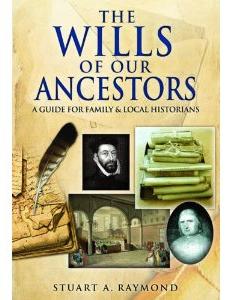
The Wills of Our Ancestors - review
This is a review of sorts - the problem being that the book I'm featuring is one that I haven't finished yet! However, I am so impressed with what I've trawled through already that I want to make sure you're able to get it before Christmas!
I recently received a copy of Stuart A. Raymond's new book The Wills of Our Ancestors: A Guide for Family and Local Historians, published by Pen and Sword. Often books written down south on apparently universal record types that cover the UK will be primarily about England and Wales, and have a token 2 pages on Scotland and/or Ireland as if somehow they're just an appendix to the main event, instead of a subject that can be as equally complex and detailed as the other two countries of the UK. This book unashamedly states on the first page that it does deal primarily with England and Wales, and doesn't claim otherwise. No problem, that's great - so why am I so excited by it, as an Ulsterman living and working in Scotland, and primarily within Scottish genealogy?
Even when something is about England and Wales, territories in which I only occasionally do client work in, I always like to find something to latch onto in a book that I can relate to before looking at the stuff I don't usually deal with. So the first thing I did was to go through to the Scottish part, on page 96, to see how well covered the situation was here. It's only four pages, but it's really well written. For such a short section it packs in a hell of a lot, and doesn't just say 'go to ScotlandsPeople'! Good start - at this point it's a book about England and Wales, but it has a decent Scottish section (and Ireland, the Channel Islands and Man are equally give the punchy treatment). So then I went to the start of the book - and that's when it really took off...
Stuart's introduction within the first few pages does something you don't often find when people deal with Britain - it provides an understanding of how the legal systems in both Scotland and England used to deal with probate before the respective Reformations in both countries, and before they went down different routes from the 16th century onwards (1540 down south, 1560s here in Scotland). He starts off with a brief description of how wills originated in feudal England - and by doing so he's allowed me to understand how similar the systems for probate once were north and south of the border. It makes perfect sense, with the two countries using the Roman Catholic ecclesiastical courts for some of the process, and the respective Crowns in both countries to retain controls over the inheritance of land under the feudal system. It's actually quite a short introduction, but it basically allowed me as someone more clued up on the Scottish system to twig how the English system evolved.
From this point on it's fairly much about England and Wales all the way, and well written with topics such as the physical process of English probate, the location of records and more. It's incredibly accessible, even for a Johnny Foreigner like me - for example, on page 17 he mentions how a customary law prevailed to 1692 in the Province of York only, which denied testators an unrestricted right to dispose of moveable heritage. They had to give a third of their estate to their widow, a third to the children and then dispose of the final third themselves - exactly the same as the Scottish system (the jus relicate, the legitim and the deid's part). So I'm reading a book about a system I don't normally deal with, and completely on the right wavelength, because he's taken the care to bring me along as an 'outsider' - brilliant.
The book is structured to be two thirds background and context etc, with some useful case studies quoted along the way, and then the final third with some useful appendices, including a handy summary of pre-1858 probate courts for England and Wales, a Latin glossary, and other useful resources. If you're looking for a comprehensive guide on the subject, this is it - and if you're overseas, north of the border or just over the water, it makes the subject easily accessible.
I'm about a third of the way through it so far - and on what I've read so far, I would thoroughly recommend asking for it for your Christmas stocking! There's a print edition from Pen and Sword (www.pen-and-sword.co.uk) and also a Kindle edition via Amazon.
Chris
Having a Christmas present crisis?! Check out my range of genealogy books at http://britishgenes.blogspot.co.uk/p/my-books.html - perfect for the family historian's Christmas stocking...! Also now out - new Kindle edition of Tracing Your Family History on the Internet, from http://tinyurl.com/d3vqtz5
I recently received a copy of Stuart A. Raymond's new book The Wills of Our Ancestors: A Guide for Family and Local Historians, published by Pen and Sword. Often books written down south on apparently universal record types that cover the UK will be primarily about England and Wales, and have a token 2 pages on Scotland and/or Ireland as if somehow they're just an appendix to the main event, instead of a subject that can be as equally complex and detailed as the other two countries of the UK. This book unashamedly states on the first page that it does deal primarily with England and Wales, and doesn't claim otherwise. No problem, that's great - so why am I so excited by it, as an Ulsterman living and working in Scotland, and primarily within Scottish genealogy?
Even when something is about England and Wales, territories in which I only occasionally do client work in, I always like to find something to latch onto in a book that I can relate to before looking at the stuff I don't usually deal with. So the first thing I did was to go through to the Scottish part, on page 96, to see how well covered the situation was here. It's only four pages, but it's really well written. For such a short section it packs in a hell of a lot, and doesn't just say 'go to ScotlandsPeople'! Good start - at this point it's a book about England and Wales, but it has a decent Scottish section (and Ireland, the Channel Islands and Man are equally give the punchy treatment). So then I went to the start of the book - and that's when it really took off...
Stuart's introduction within the first few pages does something you don't often find when people deal with Britain - it provides an understanding of how the legal systems in both Scotland and England used to deal with probate before the respective Reformations in both countries, and before they went down different routes from the 16th century onwards (1540 down south, 1560s here in Scotland). He starts off with a brief description of how wills originated in feudal England - and by doing so he's allowed me to understand how similar the systems for probate once were north and south of the border. It makes perfect sense, with the two countries using the Roman Catholic ecclesiastical courts for some of the process, and the respective Crowns in both countries to retain controls over the inheritance of land under the feudal system. It's actually quite a short introduction, but it basically allowed me as someone more clued up on the Scottish system to twig how the English system evolved.
From this point on it's fairly much about England and Wales all the way, and well written with topics such as the physical process of English probate, the location of records and more. It's incredibly accessible, even for a Johnny Foreigner like me - for example, on page 17 he mentions how a customary law prevailed to 1692 in the Province of York only, which denied testators an unrestricted right to dispose of moveable heritage. They had to give a third of their estate to their widow, a third to the children and then dispose of the final third themselves - exactly the same as the Scottish system (the jus relicate, the legitim and the deid's part). So I'm reading a book about a system I don't normally deal with, and completely on the right wavelength, because he's taken the care to bring me along as an 'outsider' - brilliant.
The book is structured to be two thirds background and context etc, with some useful case studies quoted along the way, and then the final third with some useful appendices, including a handy summary of pre-1858 probate courts for England and Wales, a Latin glossary, and other useful resources. If you're looking for a comprehensive guide on the subject, this is it - and if you're overseas, north of the border or just over the water, it makes the subject easily accessible.
I'm about a third of the way through it so far - and on what I've read so far, I would thoroughly recommend asking for it for your Christmas stocking! There's a print edition from Pen and Sword (www.pen-and-sword.co.uk) and also a Kindle edition via Amazon.
Chris
Having a Christmas present crisis?! Check out my range of genealogy books at http://britishgenes.blogspot.co.uk/p/my-books.html - perfect for the family historian's Christmas stocking...! Also now out - new Kindle edition of Tracing Your Family History on the Internet, from http://tinyurl.com/d3vqtz5
Saturday, 26 May 2012
Review: Coffers, Clysters, Comfrey and Coifs
The Family History Partnership's latest publication is Janet Few's Coffers, Clysters, Comfrey and Coifs, and it's a bit of a gem. This 136 page long book is a partial reprint of some material which has previously appeared in Family Tree magazine, though with much new content, and one which aims to provide a flavour of the day to day lifestyles of our ancestors, from all walks of life, within seventeenth century England.
There are ten chapters within the book. The first starts with life at home, where we learn about the beds that our forebears slept in, how they had to make their own furniture, ate meals from hollowed out square plates (providing a 'square meal') and more. Follow on chapters deal in a similar way with with household tasks, food and drink, clothing, gardening, medicine, crime and punishment, witchcraft and leisure activities. Each is packed with anecdotes and moments to make you think "Oh that's where that comes from!" - the window originally being the 'wind-eye', to allow air and light in, the 'chairman of the board' originally being the person who sat at the chair on the end of the table or 'board', and so on.
Much of the claims in the book are given as straight fact, though one or two might be questionable - the nursery rhyme 'Ring a Ring a Roses' being a case in point, categorically described as being about the plague, when in fact there's something of a debate about that amongst folklorists - but this is nevertheless a fun book that does what it sets out to do, to take you back in time to another era. And this is the first book I've read to tell me about the roll of the "piss prophet", a job that makes me extremely grateful that I have taken the career route that I have!
Each chapter is not only beautifully illustrated in colour throughout, but also ends with a further reading list to take your understanding of the topic in question further.
The Family History Partnership £12.95 +p&p
www.thefamilyhistorypartnership.co.uk
NB: The title does not appear to be listed on the company's website yet, though should be there imminently.
(With thanks to Terry Walsh at the Family History Partnership)
Chris
British GENES on Facebook at www.facebook.com/BritishGENES and Twitter @chrismpaton
There are ten chapters within the book. The first starts with life at home, where we learn about the beds that our forebears slept in, how they had to make their own furniture, ate meals from hollowed out square plates (providing a 'square meal') and more. Follow on chapters deal in a similar way with with household tasks, food and drink, clothing, gardening, medicine, crime and punishment, witchcraft and leisure activities. Each is packed with anecdotes and moments to make you think "Oh that's where that comes from!" - the window originally being the 'wind-eye', to allow air and light in, the 'chairman of the board' originally being the person who sat at the chair on the end of the table or 'board', and so on.Much of the claims in the book are given as straight fact, though one or two might be questionable - the nursery rhyme 'Ring a Ring a Roses' being a case in point, categorically described as being about the plague, when in fact there's something of a debate about that amongst folklorists - but this is nevertheless a fun book that does what it sets out to do, to take you back in time to another era. And this is the first book I've read to tell me about the roll of the "piss prophet", a job that makes me extremely grateful that I have taken the career route that I have!
Each chapter is not only beautifully illustrated in colour throughout, but also ends with a further reading list to take your understanding of the topic in question further.
The Family History Partnership £12.95 +p&p
www.thefamilyhistorypartnership.co.uk
NB: The title does not appear to be listed on the company's website yet, though should be there imminently.
(With thanks to Terry Walsh at the Family History Partnership)
Chris
British GENES on Facebook at www.facebook.com/BritishGENES and Twitter @chrismpaton
Scotland's Greatest Story research service www.ScotlandsGreatestStory.co.uk and www.facebook.com/ScottishGenealogyResearch
Saturday, 12 May 2012
Book review: Tracing Your Ancestors from 1066 to 1837
Tracing Your Ancestors from 1066 to 1837
Jonathan Oates
Very much designed to take your research much further back before civil registration commenced in England, this book is structured over 12 chapters and is packed with all sorts of hints, resource definitions, history and more. The first chapter is a handy ready reckoner of English history with some of the key moments of genealogical interest, such as the Reformation of the 1530s, Tudor England, the Hanoverian period and more, all easily laid out and defined.The second and third chapters provide a comprehensive overview of the church's role and the records generated at various levels within the Anglican hierarchy, whilst Chapter 4, The Professionals, looks at those with careers in the professions, the military and beyond. Chapters 5 and 6 look at England's complicated array of civil and criminal courts, covering various jurisdictions from the assize courts to those of the palatinates. In the remaining chapters, there's a perhaps surprisingly short chapter on manorial records, a hefty look at property based records and good coverage of taxation records, published sources and more.
It's not a book for a beginner, but it is an excellent beginning for those who wish to get to the next level with their research. Packed with illustrations, and with some great insight from a borough archivist dealing with such records on a daily basis, this is a definite for the family history library.
RRP £12.99, paperback, published by Pen and Sword
[w] www.pen-and-sword.co.uk/tracing-your-ancestors-from-1066-to-1837/p/3430/
(With thanks to Pen and Sword)
Chris
British GENES on Facebook at www.facebook.com/BritishGENES and Twitter @chrismpaton
Jonathan Oates
Very much designed to take your research much further back before civil registration commenced in England, this book is structured over 12 chapters and is packed with all sorts of hints, resource definitions, history and more. The first chapter is a handy ready reckoner of English history with some of the key moments of genealogical interest, such as the Reformation of the 1530s, Tudor England, the Hanoverian period and more, all easily laid out and defined.The second and third chapters provide a comprehensive overview of the church's role and the records generated at various levels within the Anglican hierarchy, whilst Chapter 4, The Professionals, looks at those with careers in the professions, the military and beyond. Chapters 5 and 6 look at England's complicated array of civil and criminal courts, covering various jurisdictions from the assize courts to those of the palatinates. In the remaining chapters, there's a perhaps surprisingly short chapter on manorial records, a hefty look at property based records and good coverage of taxation records, published sources and more.It's not a book for a beginner, but it is an excellent beginning for those who wish to get to the next level with their research. Packed with illustrations, and with some great insight from a borough archivist dealing with such records on a daily basis, this is a definite for the family history library.
RRP £12.99, paperback, published by Pen and Sword
[w] www.pen-and-sword.co.uk/tracing-your-ancestors-from-1066-to-1837/p/3430/
(With thanks to Pen and Sword)
Chris
British GENES on Facebook at www.facebook.com/BritishGENES and Twitter @chrismpaton
Scotland's Greatest Story research service www.ScotlandsGreatestStory.co.uk and www.facebook.com/ScottishGenealogyResearch
Saturday, 28 April 2012
Review - Tracing Your British Indian Ancestors
Pen and Sword have kindly sent me through some family history titles to review, so here goes with the first!
Tracing Your British Indian Ancestors
Emma Jolly
It was not that long ago that I discovered that I had a few connections to India. On the one hand, a cousin of my grandfather, Rev. William Paton, worked as a missionary there in the early 20th century, counting Mahatma Ghandi as one of many Indians with whom he would have regular dealings. More specifically to my own bloodline is my connection through my three times great grandfather Alexander William Halliday. Alexander's death entry in a military muster roll in 1866 pointed out that he had an Indian birth, but the person who found the actual birth record for me at the British Library was genealogist Emma Jolly.
Based in London, Emma lives and breathes British Indian research, and so as a prospective author for a title in the Pen and Sword "Tracing" series, there was no better candidate. As with other titles in the range, Emma's work very much focusses on how to get the best from the vast myriad of resources both offline and online that can help with the subject matter at hand. In that regard it is as competent as some of the best in the range, but the thing that I really like about this book is the fact that it did not just tell me about those resources, it also told me about the very history of British India itself, with some occasional and surprising gems. For one thing, I had no idea that Scotland temporarily tried to compete with the English East India Company in the east through "The Company of Scotland Trading to Africa and the Indies", which lasted just a few years from 1695 (have only just twigged that this was the same company behind the Darien disaster!) For another, the colonial connections of the British Empire to China and Africa become greatly crystallised when you realise how important the role of India was as the lynchpin of that empire. It's one of the few books that I've read where I actually understand that empire.
The book is structured across ten chapters. the first provides a solid overview of the key repositories and societies that can help with your research, from the British Library and the National Library of Scotland to the Families in British India Society. The next three chapters are where the fun really begins with a comprehensive overview of the history of the East India Company and the subsequent Raj. Chapter 5 sees a full discussion on the research of military forces, both raised locally and dispatched from Britain (with Alexander Halliday and his father William making a guest appearance on p.72!). Subsequent chapters deal with maritime industries and merchants, schools, religion, the railways and more. Chapter 9 has a helpful guide to probate research in India, whilst the final chapter deals with India after 1947, and the end of the British Empire.
A thoroughly solid and enjoyable read from start to finish, this provides both a definitive history for beginners and a comprehensive family history guide for all to the greatest asset of the former British Empire.
£14.99, paperback (£10.30 through P&S - see www.pen-and-sword.co.uk/Tracing-Your-British-Indian-Ancestors/p/3356/)
(With thanks to Pen and Sword)
Chris
British GENES on Facebook at www.facebook.com/BritishGENES and Twitter @chrismpaton
Tracing Your British Indian Ancestors
Emma Jolly
It was not that long ago that I discovered that I had a few connections to India. On the one hand, a cousin of my grandfather, Rev. William Paton, worked as a missionary there in the early 20th century, counting Mahatma Ghandi as one of many Indians with whom he would have regular dealings. More specifically to my own bloodline is my connection through my three times great grandfather Alexander William Halliday. Alexander's death entry in a military muster roll in 1866 pointed out that he had an Indian birth, but the person who found the actual birth record for me at the British Library was genealogist Emma Jolly.Based in London, Emma lives and breathes British Indian research, and so as a prospective author for a title in the Pen and Sword "Tracing" series, there was no better candidate. As with other titles in the range, Emma's work very much focusses on how to get the best from the vast myriad of resources both offline and online that can help with the subject matter at hand. In that regard it is as competent as some of the best in the range, but the thing that I really like about this book is the fact that it did not just tell me about those resources, it also told me about the very history of British India itself, with some occasional and surprising gems. For one thing, I had no idea that Scotland temporarily tried to compete with the English East India Company in the east through "The Company of Scotland Trading to Africa and the Indies", which lasted just a few years from 1695 (have only just twigged that this was the same company behind the Darien disaster!) For another, the colonial connections of the British Empire to China and Africa become greatly crystallised when you realise how important the role of India was as the lynchpin of that empire. It's one of the few books that I've read where I actually understand that empire.
The book is structured across ten chapters. the first provides a solid overview of the key repositories and societies that can help with your research, from the British Library and the National Library of Scotland to the Families in British India Society. The next three chapters are where the fun really begins with a comprehensive overview of the history of the East India Company and the subsequent Raj. Chapter 5 sees a full discussion on the research of military forces, both raised locally and dispatched from Britain (with Alexander Halliday and his father William making a guest appearance on p.72!). Subsequent chapters deal with maritime industries and merchants, schools, religion, the railways and more. Chapter 9 has a helpful guide to probate research in India, whilst the final chapter deals with India after 1947, and the end of the British Empire.
A thoroughly solid and enjoyable read from start to finish, this provides both a definitive history for beginners and a comprehensive family history guide for all to the greatest asset of the former British Empire.
£14.99, paperback (£10.30 through P&S - see www.pen-and-sword.co.uk/Tracing-Your-British-Indian-Ancestors/p/3356/)
(With thanks to Pen and Sword)
Chris
British GENES on Facebook at www.facebook.com/BritishGENES and Twitter @chrismpaton
Scotland's Greatest Story research service www.ScotlandsGreatestStory.co.uk and www.facebook.com/ScottishGenealogyResearch
Subscribe to:
Posts (Atom)