Showing posts with label catalogues. Show all posts

Thursday, 4 October 2018

New Library Search catalogue coming to National Library of Scotland

The National Library of Scotland (www.nls.uk) has a new catalogue coming its way:

Library Search

Library Search is a new National Library of Scotland service which will replace the main catalogue and provide wider access to our collections.

It will bring together, in a single search, details of our printed, manuscript and archive, moving image and digital collections, as well as high quality e-resources and databases from a range of publishers.

Library Search is scheduled to be in place by November 2018.


Included in Library Search are:
  • More than five million records from our print collections, including books, maps, journals, newspapers and music
  • Almost five million electronic legal deposit items
  • Records of 35,000 items from our archives and manuscript collections
  • Hundreds of thousands of digitised resources from our collections, including digitised books, maps, photographs, posters, music, and films from the Moving Image Archive
  • Millions of articles from full-text newspapers, journals and reports
  • Thousands of electronic books, including many reference works
  • Millions of records and abstracts from online services, digital archives and databases.

The new service brings several benefits. You can:
  • Refine searches by format, subject, year, etc
  • Access a wide range of electronic resources
  • Request materials for consultation in our reading rooms
  • Receive notification when items you've requested are ready for you
  • Review your borrowing history.

Further information is available at https://www.nls.uk/catalogues/library-search

Pic: NLS, (c) Kim Traynor. Creative Commons license

Chris

For my genealogy guide books, visit http://britishgenes.blogspot.co.uk/p/my-books.html, whilst details of my research service are at www.ScotlandsGreatestStory.co.uk. Further content is also published daily on The GENES Blog Facebook page at www.facebook.com/BritishGENES.

Sunday, 3 June 2018

June's PRONI stakeholder forum meeting in Belfast

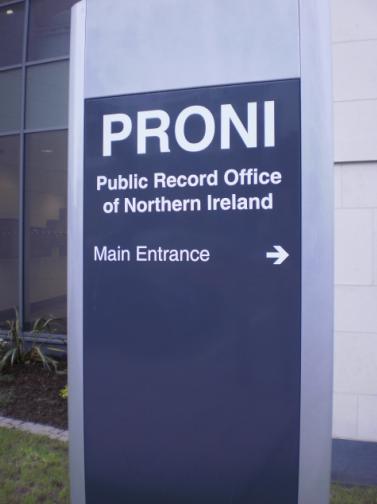
On Friday 1 June 2018 I attended the latest Public Record Office of Northern Ireland (www.nidirect.gov.uk/proni) user forum meeting in Belfast. Upon arrival I was greeted by Stephen Scarth, who handed me a copy of the new Plantations of Ulster, 1640-41: A Collection of Documents guide, which has been reprinted and updated, and which I will review separately – suffice to say, the smile on Stephen's face and on everyone else who received a copy was well warranted!

The meeting started with a demonstration of PRONI's contribution to the Conflict Archive on the Internet (CAIN) web platform. This is a platform which has been up and running for a few years now, and which is essentially an official record of The Troubles, with documents from governments north and south, and in England, concerning the last 40 years. Access to PRONI's contributed records is available through the CAIN archive's website at http://cain.ulst.ac.uk/proni/index.html. On 10 MAY 2018, some 500 document records from 1988-89 and earlier were added, some 2200 pages of content, following the latest 20 year release of government papers, covering politics, security, the economy, Harland and Wolfe, the Irish language, education, social issues, health, and much more, including the talks at the time about ending the conflict. The archive presents the records in thematic areas or by annual listings (though not chronologically within a year), and contains a fascinating insight into our Troubled society at the time. There was some very Sir Humphrey type language in parts, with phrases such as 'spotting icebergs' used in one document to mean unexpected items coming their way, etc!

Another topic discussed was one that might be of interest to Northern Irish folk who experienced life in the Troubles, the possible establishment of an oral history archive, as posited in the 2014 Stormont agreement. Such an archive will need to be established by legislation, and so a consultation is currently under way, which closes on 10 SEP 2018. The consultation is online at https://www.gov.uk/government/consultations/addressing-the-legacy-of-northern-irelands-past.

We then had an update on recent acquisitions. These include papers relating to PACE (Protestant and Catholic Endeavour) from 1992-2018, a single volume from 1919 containing an inventory of household goods belonging to Robert Young (of Young and Mackenzie architects), and 121 diaries of a Major Henry John Furnace Potter covering 1941-2000 – though sadly, most of us who were in the room will never likely see them, as they have a 50 year closure on them, as requested by the family.

On cataloguing, the Londonderry Papers have had more work on them including records relating to the Women's Legion from the 1930s and 1940s, and Mount Stewart estate papers from 1933-35. PRONI's efforts to digitise recently borrowed Anglican and Methodist records has now been completed for this year – for more on this, and a summary of all digitised records that can be accessed on site at PRONI (including those added last year), see http://britishgenes.blogspot.com/2018/06/new-digitised-northern-irish-church.html. The records will be available through PRONI's on site catalogue from autumn.

On the exhibitions front, Northern Lights: A Century of Design by Young and Mackenzie Architects kicks off on 7 June, with a lecture on site at 1pm by Paul Harron, and after finishing a stint in PRONI the exhibition will then travel across Northern Ireland. There will also be a Spanish Flu conference at PRONI at 2pm on 14 June 2018.

The big event for this year will be the Voices and Votes: Suffrage and Representation of the People 1832-1928 exhibition, commemorating the 1918 Representation of the People Act centenary which extended the vote to women for the first time. We had a sneak peak at parts of the exhibition, which launches on 2 July 2018, and which will look at the legislation, who championed the change, the early experience of women, suffragists and suffragettes, women, class and war, reform, equality, and much more. The exhibition panels will also include QR (Quick Response) codes for attendees to engage with on their mobile devices, lining to other websites and more. In addition, an exciting addition to the Spatial NI website will see an interactive map with links to documents and stories at various locations across Northern Ireland linked to the fight for the vote. There will also be a graphic novel launched to illustrate the stories of Lady Edith Londonderry and Countess Markiewicz, which will tie in to the key stage 3 of the Northern Irish schools curriculum. There will be a few other events and releases tied into the exhibition, so keep an eye on the PRONI website for more details!

A further exhibition in the works is one on prisons in Northern Ireland, from bridewells to the present day, mostly dealing with the late 19th and early 20th century.

On publications, as well as the new Plantations of Ulster, 1640-41: A Collection of Documents reproduction, PRONI is currently working on a re-invention of its former Steps to Partition facsimile pack, for release in September. The exact format of this is still being worked on, but there may be two versions, one for school use, and one in more depth for a more general release.

Finally from the meeting, PRONI is still working on being Northern Ireland's first accredited archive, and made its submission in March, with assessors visiting the archive in May. Good luck to the archive, the best in the UK as far as I'm concerned!

After finishing the meeting, I made my way to the search room, and kept bumping into folk, including Michael Rooney from Ancestor Network, and a couple called Alex and Nancy who heard me give a talk in Toronto three years ago, and who are active members of the Toronto branch of the Ontario Genealogical Society. Requisite selfies were duly acquired...!


Chris

For my genealogy guide books, visit http://britishgenes.blogspot.co.uk/p/my-books.html, whilst details of my research service are at www.ScotlandsGreatestStory.co.uk. Further content is also published daily on The GENES Blog Facebook page at www.facebook.com/BritishGENES.

Wednesday, 8 November 2017

TNA's new cataloguing initiative, and cessation of self-service printing

The National Archives in England and the Pilgrim Trust have announced a new initiative to encourage the cataloguing of archive material. The following is the announcement:

Today The National Archives and The Pilgrim Trust announce the launch of Archives Revealed, a funding programme to support the cataloguing of archive collections. This funding will support archive services across the UK to make their uncatalogued archive collections accessible and available to all.

Archives Revealed offers two kinds of support. Cataloguing grants of up to £40,000 will be available to create catalogues of archival collections. Scoping grants of up to £3,000 will also be available to help archives to conduct collection analysis which will support the development of plans for their future cataloguing priorities and projects.

Jeff James, Chief Executive and Keeper of The National Archives said:

‘I am delighted to announce the launch of Archives Revealed. Along with The Pilgrim Trust we look forward to working with archives from across the country to support their efforts in cataloguing more of their rich and diverse collections and opening them up for all to use.’

Building on the success of a previous scheme, the National Cataloguing Grants Programme for Archives, a revised funding criteria will include an assessment of the collection’s significance, including its rarity, historical value, and research value to a variety of audience groups. This will be assessed alongside demonstrated evidence of the need for the cataloguing to be completed, with an additional focus given to an analysis of current and potential impact.

Further information on the new scheme is available at http://www.nationalarchives.gov.uk/archives-sector/finding-funding/archives-revealed/. (The original press release is at http://www.nationalarchives.gov.uk/about/news/archives-revealed-new-funding-programme-support-cataloguing-archive-collections/)

The National Archives has also announced that the facility will no longer provide self-service printing facilities or camera stations for users onsite. users will be able to bring cameras to the facility still, whilst digital downloads will be permitted which can be emailed home free of charge. For further details on this visit the archive's announcement at http://www.nationalarchives.gov.uk/about/news/changes-to-self-service-copying-facilities-from-11-december-2017/.

Chris

My next 5 week long Scotland 1750-1850: Beyond the OPRs course commences Nov 6th 2017 - details at https://www.pharostutors.com/details.php?coursenumber=302. For my genealogy guide books, visit http://britishgenes.blogspot.co.uk/p/my-books.html, whilst details of my research service are at www.ScotlandsGreatestStory.co.uk. Further content is also published daily on The GENES Blog Facebook page at www.facebook.com/BritishGENES.

Wednesday, 31 May 2017

Recent PRONI cataloguing and records digitisation

I'm looking forward to attending my first PRONI (www.nidirect.gov.uk/proni) user forum meeting in Belfast on Friday, having missed the last couple of meetings. I've just received the minutes form the last meeting, and thought it would be worth sharing the news on recent cataloguing and digitisation initatives at the archive:

Church records to be digitised:

Dromore Cathedral – four registers, the earliest of which is a combined register dating from 1784-1816. [Also individual birth, marriage and burial register dating from 1816 up to 1845/1853]. PRONI already holds copies of the registers on mmicrofilm but the quality of the reels has deteriorated over the years.

St George’s Parish Church – 4 baptism registers dating from 1817-1880.

St Mary Magdalene’s Church, Donegall Pass, has deposited 3 registers with PRONI dating from 1847-1871, vestry minutes and a register of vestry men with us.

St Aidan’s Parish Church, Blythe Street, deposited marriage registers for Christ Church dating from 1855-1875.

St Andrew’s marriage register (1870-1889) and three workhouse baptismal registers dating from 1886-1903; 1903-1922 and 1922-1933.

St Luke’s Parish Church, Mullaglass – 3 registers dating from 1852-1880, a minute book and a register of vestry men dating from 1870.

NB: These records will be digitised for consultation at PRONI only, not for any form of online release.


Recent cataloguing:

D4631 – The most sizeable accession was a large collection (over 100 PRONI boxes) from the Hearth Housing Association. The collection comprises bills of quantities, architectural drawings, correspondence, funding applications and reports in relation to conservation projects undertaken on buildings of historic importance (1978-2014).

D4633 – the Northern Ireland’s Women’s Football Association [minutes of AGMs, League and Committee meetings; fixtures; correspondence; player’s registration forms; rules; programmes; newsletters and newspaper cuttings. The papers range in date from c. 1979-1992 and comprise c. 1000 documents within 10 folders].

D4634 – the Northern Ireland Photographic Association deposited 50 prize winning prints and digital copies of the same.


D4523 – the Brabazon Sharpe family of Galway and Mayo. The papers date from the early 1700s up until the mid-19th century. The collection includes the papers of Sir William Brabazon, 2nd Baronet of New Park (later Brabazon Park), Swinford, Co. Galway (1803-1840). Sir William was High Sheriff of Co. Mayo (1825-1827), a Justice of the Peace and an M.P. from 1835 until his death. He was a prominent individual in Irish public life, his wide-ranging correspondence touches on aspects of local administration as well as finance, family matters and estate management.


I'll update you all as to the more recent developments at PRONI this weekend.

(With thanks to Gavin McMahon at PRONI)

Chris

My next 5 week Scottish Research Online course commences Sept 11th 2017 - details at https://www.pharostutors.com/details.php?coursenumber=102.
For details on my Scottish & Irish genealogy guide books, please visit http://britishgenes.blogspot.co.uk/p/my-books.html.
For my genealogy research service, please visit http://www.ScotlandsGreatestStory.co.uk.

Monday, 22 May 2017

MyHeritage adds new collection catalogue

MyHeritage (www.myheritage.com) has introduced a new Collection Catalog on its site, which lists the historical record collections indexed and available on MyHeritage SuperSearch. From MyHeritage:

The catalog is useful for beginners as well as professional users. It lists next to the name of each collection the number of records in it and the date in which it was added or last updated, and indicates with a special icon which collections are new or recently updated. Some people call this a “card catalog” in reference to the way libraries used to index their inventory on cards in the old days, but our Collection Catalog is digital; It is available online and includes many useful functions.


For more on the new feature, visit the company's blog at https://blog.myheritage.com/2017/05/new-collection-catalog/.

(With thanks to Daniel Horowitz)

Chris

My next 5 week Scottish Research Online course commences Sept 11th 2017 - details at https://www.pharostutors.com/details.php?coursenumber=102.
For details on my Scottish & Irish genealogy guide books, please visit http://britishgenes.blogspot.co.uk/p/my-books.html.
For my genealogy research service, please visit http://www.ScotlandsGreatestStory.co.uk.

Monday, 5 December 2016

Latest PRONI stakeholder forum update

Last Friday saw the latest stakeholder forum of the Public Record Office for Northern Ireland (https://www.nidirect.gov.uk) in Belfast. I was unfortunately not able to attend, as I developed a nasty bout of Black Death towards the end of the week (some folk call it a 'cold'!), but I am grateful to Richard Lecky for forwarding the minutes to me. The following are some of the key developments that will be of interest to regular PRONI users:


1) The annual release of official files under the 20 Year Rule (the ‘Annual Sensitivity Review’) will officially take place on December 30th. There will be a ‘Secrets Behind the Files’ event at 1pm on January 11th 2017, led by Dr Eamon Phoenix (political historian) and Sam McBride (political editor, the Newsletter) discussing some of the key finds from the release. The talk is an open event, with the public able to register to attend via the PRONI website.

2) The Conflict Archive on the Intenet project (CAIN) has now added files from 1987, with work currently progressing to capture 1988.

3) With regards to new accessions of private records, a large collection of papers relating to the Christian Endeavour society has been acquired, catalogued under D4628. This organisation originated in America in 1881, with societies opening in Belfast soon after. By 1899 there were 10,000 members and one hundred societies throughout Ireland (as a wee boy growing up in Carrickfergus in the 1980s the society was certainly still going strong then in my church). The collection contains correspondence, minutes and reports and printed material and dates from 1900.

The Papers of Fred Heatley, founding member of NICRA and People’s Democracy, have been added D4629. Amongst the political scrapbooks in this collection are a range of political posters.

Eight pre-1871 registers from the Methodist Historical Society have been transferred to PRONI for digitisation - the registeres are from the following Belfast Churches: Ligoniel, Frecerick Street, Salem New Connection, and Ballymacarett (Newtownards Road).

4) Cataloguing continues at PRONI, as follows:
Records of the Irish Council of Churches have almost been completely catalogued, and are found under D4602/1. The collection includes minutes, reports and correspondence and dates from its foundation to recent years.

Family papers relating to the Johnston family of Slaghtbogie, Maghera, Co. Londonderry (from 1766-1943), are being catalogued under D4618. The papers give an insight into the family’s relationship with their tenants and neighbours and into the experiences of some family members who emigrated to America and Canada.

Cataloguing has been completed on the papers of Kevin Boyle (D3297). The collection vividly captures the early years of the civil rights movement in Belfast.

A land valuation volume and watercolour maps of the estate of Thomas Brooke at Lough Eske, Co. Donegal, and watercolour maps of the lands of the Marquis of Conyngham (dating from the 1890s), Glenties, Co. Donegal (dating from 1839), have been catalogued under D4493.

5) The new GIS Application / Historical Maps viewer:
Particularly good news is the fact that PRONI’s new Historical Maps viewer is hopefully going to go live at some point this week. There will hopefully be an official launch early next year (provisionally slated for January 25th 2017 at PRONI, 9.30am – 1pm), with an accompnaying half day conference around geographical mapping. (I've seen this demonstrated at a couple of previous forum meetings, and this is definitely going to become a tool that everyone doing Northern Irish research will need to bookmark.)

6) The new Rule and Fees will come into effect on the 15th December and PRONI is on track to make all the necessary amendments. The PRONI web page has been updated with a new link so users can see the new fees and charges - see https://www.nidirect.gov.uk/articles/are-there-any-fees-and-charges.

7) Preservation week will run from December 12th-16th. This is the week when PRONI takes time to play catch up with various internal issues, with the net result that although the building will be open as normal, there will be no document ordering available for the week, only the self-service facilities.


8) Forthcoming events and exhibitions:

Holocaust Memorial Day: The Holocaust event will be taking place on Thursday the 26th of January and Teddy Dixon, who was one of the soldiers that liberated Dachau, will be interviewed by Dermot Lavery from Doubleband.

History of Football in Ireland Conference: A History of Football conference will be held on the 17th of February and is being organised by Dr Chris Curran.

International Women’s Day: The International Women’s Day will be held on the 8th of March and feature journalist, Malachy O’Doherty

For further events see https://www.nidirect.gov.uk/articles/talks-and-events.

(With thanks to PRONI)

Chris

For details on my genealogy guide books, including A Beginner's Guide to British and Irish Genealogy, A Decade of Irish Centenaries: Researching Ireland 1912-1923Discover Scottish Church Records (2nd edition), Discover Irish Land Records and Down and Out in Scotland: Researching Ancestral Crisis, please visit http://britishgenes.blogspot.co.uk/p/my-books.html.

Tuesday, 13 September 2016

The National Register of Archives for Scotland

Following the recent publication of PRONI's annual report, I asked the National Records of Scotland if their 2016 annual report has been published yet - it hasn't, but will be in the next few weeks. However, they did kindly provide me a link to last year's report, published in November 2015 (it's at https://t.co/xNxlXDrEgQ), which allows me to give a quick plug to a resource many folk may not be aware of.

The National Register of Archives for Scotland is the catalogue that tries to pick up what other catalogues don't - namely the records still held in private hands, such as family estate papers and business records still retained by the businesses in question. The following is the NRS report's list of work carried out for the register in 2014-2015:

In June 2014, the National Register of Archives for Scotland, the body which locates and surveys historical papers in private hands and advises owners on their care and preservation, returned the newly catalogued archives of the Maclachlan of Maclachlan family to the chieftain, Euan Maclachlan, during the Homecoming Clan gathering at Castle Lachlan. We gave a talk at the gathering, highlighting some of the interesting documents identified during the cataloguing process. These ranged from 16th century title deeds, giving an insight into early Highland life and customs, to records of the Argyll Fencibles in the mid-18th century. The 19th century letters of George Campbell as Lord Lorne and then 8th Duke of Argyll, to Robert MacLachlan, shed light on the former's views on a range of issues including the Disruption of the Scottish church in 1843, schools for the new Free Church, the indebtedness of the Argyll estate, political issues at Westminster relating to free trade and political reform, and, more locally, Argyllshire roads, bridges and railways.

The NRAS catalogue is accessible on the NRS website at http://catalogue.nrscotland.gov.uk/nrasregister/welcome.aspx. If you find a collection on there of interest, you need to apply to the Register to write to the records holder on your behalf to seek permission to view them. Note that if records are held in private hands, you absolutely do not have the right to view them - it is entirely at the discretion of the owners as to whether you can or not (so be nice and humble!). As the NRAS itself states on its website, "An owner’s decision not to give access may seem arbitrary to researchers but there are often very good reasons why they cannot, and they are under no obligation to tell us why. Researchers should also remember that access to private papers is a privilege and not a right".

The process can take a while, perhaps up to a month, to get a response, but it can be certainly worth it. Many years ago, for example, I discovered that the records for the Weavers Incorporation in Perth were held in private hands through the NRAS, and after going through the process, I obtained permission to view them. Quite apart from the joys that perusing the records produced, it also opened a dialogue with the caretaker of the records, where I suggested that the local archive might be a place where they could be better stored, rather than the ad hoc arrangements that had been entered into by the records' custodians to have them looked after at that stage. About a year after I had finished with consulting the records I was delighted to learn that they had been subsequently deposited at Perth and Kinross Archives. Many collections, however, are perfectly well looked after by their custodians, indeed, treasured by them - they just simply exist beyond the public domain.

If you cannot find records that you are interested in through the National Records of Scotland catalogue (http://catalogue.nrscotland.gov.uk/nrsonlinecatalogue/welcome.aspx), or the Scottish Archive Network catalogue for local archives (www.scan.org.uk/aboutus/indexonline.htm), try the NRAS - you might just find that the records do exist!

(With thanks to the NRS)

Chris

For details on my genealogy guide books, including A Beginner's Guide to British and Irish Genealogy, A Decade of Irish Centenaries: Researching Ireland 1912-1923Discover Scottish Church Records (2nd edition), Discover Irish Land Records and Down and Out in Scotland: Researching Ancestral Crisis, please visit http://britishgenes.blogspot.co.uk/p/my-books.html.

Tuesday, 22 December 2015

Erskine Hospital project TV feature

Forces TV has a short feature on the current Erskine Hospital project to catalogue a series of objects found recently in the premises, including a register of inmates from its opening in 1916 (see http://britishgenes.blogspot.co.uk/2015/11/erskine-hospital-archive-to-be.html). The hospital was founded in 1916 to help treat soldiers requiring specialist treatment, including amputations and the pioneering use of artificial limbs.

To view the story visit http://forces.tv/65791424.

(With thanks to David McNay via Facebook)

Chris

For details on my genealogy guide books, including my recently released Discover Irish Land Records and Down and Out in Scotland: Researching Ancestral Crisis, please visit http://britishgenes.blogspot.co.uk/p/my-books.html. My Pinterest account is at https://www.pinterest.com/chrismpaton/.

Monday, 23 November 2015

Erskine Hospital archive to be catalogued

Recently found historic items and documents at the Erskine Hospital (www.erskine.org.uk), which for a century has treated military patients, are to be catalogued thanks to funding from the Wellcome Trust (www.wellcome.ac.uk). The cataloguing will be carried out by Glasgow University Archive Service, which has acquired the collection. The story is online at www.bbc.co.uk/news/uk-scotland-glasgow-west-34899609. Note also the following line in the BBC story:

Erskine are currently working on a patient database of every soldier admitted and discharged at the hospital during its history, which will become a research resource for families tracing their ancestry.

The items retrieved include original prosthetic limbs and tools.

Chris

For details on my genealogy guide books, including my recently released Discover Irish Land Records and Down and Out in Scotland: Researching Ancestral Crisis, please visit http://britishgenes.blogspot.co.uk/p/my-books.html. My Pinterest account is at https://www.pinterest.com/chrismpaton/.

Friday, 6 November 2015

Railway accident reports 1900-1910 catalogued on Discovery

The National Archives (www.nationalarchives.gov.uk) in England has catalogued Board of Trade Sub-Inspector’s Accident Reports for railway accidents from 1900-1910.

A blog post by Chris Heather, one of the participants in the cataloguing effort, is available at http://blog.nationalarchives.gov.uk/blog/railway-accident-reports-unseen-victims/ and provides a useful case study on what might be found within such a report.

To access Discovery, visit http://discovery.nationalarchives.gov.uk.

Chris

For details on my genealogy guide books, including my recently released Discover Irish Land Records and Down and Out in Scotland: Researching Ancestral Crisis, please visit http://britishgenes.blogspot.co.uk/p/my-books.html. My Pinterest account is at https://www.pinterest.com/chrismpaton/.

Friday, 30 October 2015

Newly catalogued material by National Monuments Record of Wales

The National Monuments Record of Wales has announced its latest catalogued acquisitions in October via the Heritage of Wales blog at http://heritageofwalesnews.blogspot.co.uk/2015/10/national-monuments-record-of-wales_30.html, the blog of the Royal Commission on the Ancient and Historical Monuments of Wales.

For the latest monthly lists of recently catalogued holdings, please visit www.rcahmw.gov.uk/HI/ENG/Our+Services/Donate+Records/Recent+Acquisitions/

Chris

For details on my genealogy guide books, including my recently released Discover Irish Land Records and Down and Out in Scotland: Researching Ancestral Crisis, please visit http://britishgenes.blogspot.co.uk/p/my-books.html. My Pinterest account is at https://www.pinterest.com/chrismpaton/.

Monday, 12 October 2015

Argyll archive papers to be conserved, catalogued and digitised

From the Friends of the Argyll Papers Facebook page at https://www.facebook.com/friendsoftheargyllpapers :

Written in the Landscape wins Heritage Lottery Fund support

Argyll and Bute Council and Argyll Estates have received a grant of £100,000 from the Heritage Lottery Fund (HLF) for an exciting three-year joint project to catalogue, conserve and digitise 64 Argyllshire family and estate archives.

The “Written in the Landscape” project, which will run from January 2016 until December 2018, will see the most fragile items in Argyll Estates' collection of historic maps and plans being cleaned and repaired before being digitised.

It will also create jobs for two project archivists, who will catalogue the archives so they can be accessed and understood by researchers. They will work closely with local heritage centres to identify records of greatest interest to local communities and develop a training and mentoring scheme. The project will also offer opportunities for people to develop their personal skills by volunteering in Argyll Estate Archives, the Council archives, or from their own homes.

A series of open days, tours, talks and exhibitions to promote the archives will also be delivered and a leaflet and online guide will be created which will provide information about the family and estate archives of Argyll.

Welcoming the news, the Council’s Policy Lead for Community and Culture, Councillor Robin Currie said: “This is wonderful news. Family and estate archives are unique and invaluable resources for investigating Argyll’s rich cultural, built and natural heritage. The archives represent nearly eight hundred years of local and national history. Until now much of this history has been locked away and unavailable for research. Once this project has been completed, researchers from ancestral tourists to academics will be able to access this fantastic resource to learn more about our ancestors and the routes their lives took.”

His Grace the Duke of Argyll said: "We are delighted to be part of this exciting project which will support the opening up of our archive to researchers and local communities.”

Lucy Cast, Head of the Heritage Lottery Fund in Scotland said: “Saving our historic archives has never been more important. They provide such a valuable resource for anyone who wants to delve into their past. Thanks to National Lottery players, the Heritage Lottery Fund is able to support projects such as Written in the Landscape that will enable volunteers and the wider community to learn about what life was like and how that has shaped who we are today.”

The project will run from January 2016 until December 2018 and is funded by the Heritage Lottery Fund, Argyll and Bute Council Archives, Argyll Estates, Tiree Community Windfall Trust, An Iodhlann, Inveraray CARS, Clan Campbell Education Foundation and private donations. Some additional partnership funding is needed to complete the funding package of £300,000, which should be secured by the end of this year.

(With thanks to Christine Woodcock via Facebook)

Chris

For details on my genealogy guide books, including my recently released Discover Irish Land Records and Down and Out in Scotland: Researching Ancestral Crisis, please visit http://britishgenes.blogspot.co.uk/p/my-books.html. My Pinterest account is at https://www.pinterest.com/chrismpaton/.

Friday, 9 October 2015

Manorial Documents Register moves to Discovery

News from the National Archives in England (courtesy of an update from the Federation of Family History Societies), concerning the online presentation of the Manorial Documents Register:

We would like to update you on the Manorial Documents Register (MDR) search within Discovery (http://discovery.nationalarchives.gov.uk/manor-search), which we launched earlier this summer.

The new MDR search replaces the nationalarchives.gov.uk/mdr platform, which will be retired on 30 October 2015.

The MDR identifies the nature and location of manorial records. A standard Discovery search will show general information about manorial records held at The National Archives and elsewhere; the powerful new manor search tool provides information about manorial records as defined by the Manorial Documents Rules.

More and more researchers from across the UK and beyond are using Discovery to find information about records held by other archives. We hope that integrating the MDR into Discovery will increase its visibility and make the service more accessible to all users whether they are familiar with using the MDR or not.

Originally a paper-based register, the MDR is gradually being updated and made available online. You can find up to date information about this work on our project page (http://www.nationalarchives.gov.uk/archives-sector/manorial-documents-register.htm). We would like to say thank you to all of those who have contributed to the growth of the Register and to the generosity of the funding bodies who have supported this.

The landing page for the manor search retains the title of 'Manorial Documents Register'. This is an acknowledgment of the legal status of the MDR but also demonstrates our commitment to its delivery and presentation as a defined entity in Discovery.

We have sought extensive user feedback throughout the development process and we have already implemented a number of enhancements to ensure that this resource offers the same high level of service as its predecessor. We continue to welcome feedback on the development of Discovery, which helps inform our on-going programme of documenting, prioritising and developing enhancements. Please email discovery@nationalarchives.gsi.gov.uk or use the feedback form within Discovery.


For more information searching the Register using Discovery visit: http://www.nationalarchives.gov.uk/help/accessing-records-of-mdr.htm or read our blog: http://blog.nationalarchives.gov.uk/blog/discovering-manorial-documents-register/

Jonathan Cates
Collections Knowledge Manager (Finding Archives) | Archives Sector Development
The National Archives
+44 (0) 20 8876 3444

Beryl Evans
FFHS Archives Liaison Officer
archives.liaison@ffhs.org.uk

(With thanks to both)


Chris

For details on my genealogy guide books, including my recently released Discover Irish Land Records and Down and Out in Scotland: Researching Ancestral Crisis, please visit http://britishgenes.blogspot.co.uk/p/my-books.html. My Pinterest account is at https://www.pinterest.com/chrismpaton/.

Wednesday, 7 October 2015

Cardiganshire County Medical Officer of Health reports to be catalogued

Papers of the Cardiganshire County Medical Officer of Health are to be catalogued at Ceredigion Archives in a one year project to be funded by the Wellcome Trust. From the announcement:

The collection contains approximately 100 boxes of archive material relating to public health administration in the county of Cardiganshire covering the years from 1910 to the mid 1970s. The collection is believed to be a rare survival of its kind, providing a detailed record of healthcare in a rural county.

The full announcement, with additional detail, is available at https://archifdyceredigionarchives.wordpress.com/2015/10/07/papers-of-the-cardiganshire-county-medical-officer-of-health/.

(With thanks to Audrey Collins via Facebook)

Chris

For details on my genealogy guide books, including my recently released Discover Irish Land Records and Down and Out in Scotland: Researching Ancestral Crisis, please visit http://britishgenes.blogspot.co.uk/p/my-books.html. My Pinterest account is at https://www.pinterest.com/chrismpaton/.

Wednesday, 30 September 2015

Using TNA's Discovery workshop

For those still baffled by it, the National Archives (www.nationalarchives.gov.uk) down in England is running a free 45 minute session on how to get the best out of its Discovery catalogue system. The session takes place on Tuesday, 6 October 2015 from 11:15 to 12:00 at the archive in Kew.

Further details on the session are available at http://www.eventbrite.co.uk/e/using-discovery-getting-the-most-from-our-online-catalogue-tickets-18467919043


Chris

For details on my genealogy guide books, including my recently released Discover Irish Land Records and Down and Out in Scotland: Researching Ancestral Crisis, please visit http://britishgenes.blogspot.co.uk/p/my-books.html. My Pinterest account is at https://www.pinterest.com/chrismpaton/.

Monday, 3 August 2015

Recently catalogued collections by National Monuments Record of Wales

The latest monthly edition of the National Monuments Record of Wales (NMRW) Archives and Library Bulletin, which lists all newly catalogued materials by the body, is available online at http://heritageofwalesnews.blogspot.co.uk/2015/08/national-monuments-record-of-wales.html.

For previous months' editions going back to December 2013, please visit www.rcahmw.gov.uk/HI/ENG/Our+Services/Donate+Records/Recent+Acquisitions/

Chris

For details on my genealogy guide books, including my recently released Discover Irish Land Records and Down and Out in Scotland: Researching Ancestral Crisis, please visit http://britishgenes.blogspot.co.uk/p/my-books.html.

Sunday, 31 May 2015

National Archives of Ireland needs to step up a gear with its online catalogue

I've just had a look at the additions to the National Archives of Ireland's online catalogue (www.nationalarchives.ie/research/what%E2%80%99s-new-in-the-online-catalogue/2015-updates/). There's some fairly tedious government material from 2014 and 2015, but some resources that may be of interest to family historians include the following:
  • Galway District Probate Registry 1988 (2013/103)
  • Galway District Probate Registry 1989 (2013/104)
  • Galway District Probate Registry 1990 (2013/105)
  • County Carlow Finance Compensation Files (FIN/COMP/2/1) (197 files)
  • County Donegal Finance Compensation Files (FIN/COMP/2/5) (840 files)

The latter two entries on compensation files relate to the post Irish Civil War Compensation Act of 1923.

Unfortunately that is about as detailed as the catalogued entries get, on what is one of the world's least friendly online archive catalogues. If you compare the online catalogue from the Public Record Office of Northern Ireland at http://apps.proni.gov.uk/DCAL_PRONI_eCatNI_IE/SearchPage.aspx with that from the National Archives of Ireland at www.nationalarchives.ie/search-the-archives/ you are looking at the difference between the light provided in daytime and the lack of it at night.

When I look at the PRONI catalogue from my home here in Scotland I can ascertain a great deal of information that allows me to judge whether it is worth a visit over to Belfast. For example, on one occasion last year I discovered a PRONI catalogue entry mentioning that the archive held a copy of a school log book once kept by my four times great grandfather John Montgomery from Islandmagee. I hopped straight onto a ferry the following day to see it, and was stunned to find a lot of genealogical information scribbled within it, concerning John, a sister I never knew about, and John's land holdings in Islandmagee - that, plus of course details of many pupils who he taught, including several of my relatives. I was able to do so because I was able to get the heads up from the PRONI catalogue.

Some Irish records have been helpfully catalogued on platforms such as RASCAL (www.rascal.ac.uk) and the Irish Archive Resource (www.iar.ie). But the National Archives of Ireland, whilst having some success in recent years on the digitised collections on its genealogy site at www.genealogy.nationalarchives.ie, really needs to up its game on its online catalogue provision. I have no doubt that the archive has a tonne of material waiting to be plundered concerning both my family from the north and in Dublin, as well as for my wife's family in Kilkenny and Tipperary - but I am not going to just fly to Dublin and hope that I can find it whilst there. Time is money for such trips, and I need to be able to plan what I want to see in advance, something I can adequately do in advance of visits to Belfast, Edinburgh, London, but sadly, as yet, not Dublin.

How many other people would similarly consider consulting the NAI's collections if they could only see what it actually holds? Personally, I would be much happier if NAI held back on the digitisation efforts now for a bit, and started to put some more effort into its cataloguing programme.

Chris

The latest British GENES podcast is available at http://britishgenes.blogspot.co.uk/p/podcasts.html. For details on my latest book Down and Out in Scotland: Researching Ancestral Crisis, and my other genealogy guide books, please visit http://britishgenes.blogspot.co.uk/p/my-books.html.

Friday, 24 April 2015

National Records of Scotland catalogue back up

After four weeks of being offline, the National Records of Scotland catalogue is now back up at http://catalogue.nrscotland.gov.uk/nrsonlinecatalogue/search.aspx. Other services such as SCAN (www.scan.org.uk) also appear to be back up.

And about time too.

Chris

For details on my latest book Down and Out in Scotland: Researching Ancestral Crisis, and my other genealogy guide books please visit http://britishgenes.blogspot.co.uk/p/my-books.html. To commission me for genealogical research, please visit my research site at www.scotlandsgreateststory.co.uk.

Monday, 30 March 2015

More problems with National Records of Scotland computer services

The National Records of Scotland (www.nrscotland.gov.uk) has announced that it is again suffering technical problems with its computer services, including access to the NRS Catalogue, the NRAS Register, the SCAN Catalogue, the Tartan Register Scottish Documents, the Scottish Archives for Schools, and the Scottish Handwriting platforms. The problems also appear to be affecting service provision to the Historic Search Room computers, and the NAS Enquiries mailbox. The problems do not appear to be affecting the on site ScotlandsPeople service provision or the main NRS website itself. From the NRS Twitter feed (@NatRecordsScot), this appears to have been a problem since Friday of last week.

For further details visit http://www.nrscotland.gov.uk/news/2015/nrs-online-and-onsite-services

Chris

For details on my latest book Down and Out in Scotland: Researching Ancestral Crisis, and my other genealogy guide books please visit http://britishgenes.blogspot.co.uk/p/my-books.html. To commission me for genealogical research, please visit my research site at www.scotlandsgreateststory.co.uk.

Tuesday, 6 January 2015

National Records of Scotland catalogues unavailable this weekend

The National Records of Scotland has announced that its online catalogue, accessible via www.nrscotland.gov.uk, will not be accessible this forthcoming weekend. The following is the announcement:

Downtime notice: Due to essential work on our servers this service will be unavailable from 23:59 on Friday 9 January until 23:59 on Sunday 11 January (i.e. all day Saturday and Sunday).

The downtime will also affect the Scottish Archive Network catalogue at www.scan.org.uk/catalogue.

Chris

For details on my range of genealogy guide books please visit http://britishgenes.blogspot.co.uk/p/my-books.html. To commission me for genealogical research, please visit my research site at www.scotlandsgreateststory.co.uk.