Showing posts with label industry. Show all posts

Monday, 7 September 2015

Latest news from PRONI user forum

On Friday I attended the latest user forum meeting at PRONI (www.proni.gov.uk) in Belfast. The following is a quick summary of developments, including one VERY special project on the cards just now!

Graham Jackson gave us a quick overview on the release of the latest government files from 1987 (releases are now occurring twice a year, to help accommodate the change from a 30 year closure period to 20 years - files that were originally closed for 30 years but older than 20 can now be released). Records include various papers from the aftermath of the Anglo-Irish Agreement.

On the cataloguing front, Brett Irwin then informed us that administrative papers and general records of the Reformed Presbyterian Church from 1811-1979 have now been catalogued at CR5/5 (the church's Synod's first meeting was in Cullybackey in 1811). About 800 photos from the Londonderry Papers, mainly from Mount Stewart House, have also been catalogued now at D4567, comprised of photos and albums of the 7th Marquess of Londonderry and his wife Lady Edith and family. (It is envisaged that there will be an autumn lecture series on the Derry papers, kicking off in October and running into next year).  Brett also informed us that amongst new records deposited at PRONI have been records from the Irish Council of Churches (from 1923) and the Irish Inter-Church Meeting (from 1973), which should be catalogued in the next eighteen months.

Janet Hancock then updated us on a current fees and rules/regulations review process going on at the archive. Fees have not having been reviewed since 2009 and the subsequent move to Titanic Quarter. It is likely that the fee for several backroom services which charge will likely go up, but the whole thing has to go to the minister and to a public consultation in due course. Some of the proposed changes will affect areas such as visitor registration and copyright awareness when making copies of images. On the copying front, PRONI is still looking into the option of allowing photography, and it seems that photocopying at the facility will soon become an endangered species (for conservation/preservation of records reasons), with an increased use of overhead scanning capabilities and other means. On the options for making personal copies, it was mentioned that PRONI was likely going to take a precautionary negative approach on hand held scanners. I queried if this might include devices such as a FlipPal, but it looks like PRONI is really not keen for any device that makes contact with a document to be used.

Then came the highlight of the day! Janet demonstrated to us a new platform that PRONI is working on to provide a new online mapping service, providing historical access to geo-referenced historic Ordnance Survey maps, with optional historical data layering added that might flag up places and subjects of interest. This is very much a work in progress, but sparked a very enthusiastic discussion from all in attendance, with all sorts of possible projects that might be considered for layering data, from plotting the locations of old churches, to bomb drop sites in the Blitz and the identification of historic railway sites. I came away from the meeting thinking that this could give the National Library of Scotland maps site a good run for its money in due course, in terms of brilliance! Other layers that are currently planned include parish, boundary, county and townland boundaries, and it is hoped that the initial launch version of the project will be made available at some point in this business year, but as I mentioned, it is a work in progress. The old maps to be used in the first instance will likely be the first edition set of 6" maps, and a revision set from the early 1900s. I suspect this will start off gently, and just grow and grow - the potential for interaction with user groups that might be able to add project layers data on a range of topics is huge, but the team are still finding their feet with it, and need to walk first before they can run! Very exciting development though.

On forthcoming events, there is a lecture series soon on County Down, and in November Foras na Gaeilge will be running another four part lecture series. PRONI itself will be open on Saturday 12th and Sunday 13th September for European Heritage Week - this will include a full productions service on Saturday, and self-service facilities (microfilms etc) on Sunday. Both days from 9am-4.45pm. PRONI is also working on a work pack to discuss women's suffrage, as part of the Decade of Centenaries commemorations, and is also looking to do something on the 1916 Easter Rising from a northern perspective. Next year PRONI will also be running a conference about the First World War at sea, to tie in with the anniversary of the Battle of Jutland, and will also be tackling the Battle of the Somme, which will undoubtedly be of interest to many.

A few other quick notes - PRONI will close for Preservation Week again in early December, and the penultimate episode of the current run of Who Do You Think You Are will feature the archive. Gillian Hunt of the Ulster Historical Foundation also informed us that a ten week long family history course kicks off at Stranmillis College from Tuesday September 29th 20156 - for further details see www.ancestryireland.com/latest-news/new-family-history-course-stranmillis-college/.

Importantly, there is then this...


For years, this bridge over the Lagan into Belfast City Centre has quite literally done my head in, as its entry and exit steps on either side used to spin around in a tight spiral, and to get to the entrance you would usually end up banging your head somewhere against the whole sorry edifice (I'm six foot tall, not a hobbit!). Belfast - THANK YOU for rebuilding each end! I got home this time without a headache....!!!!

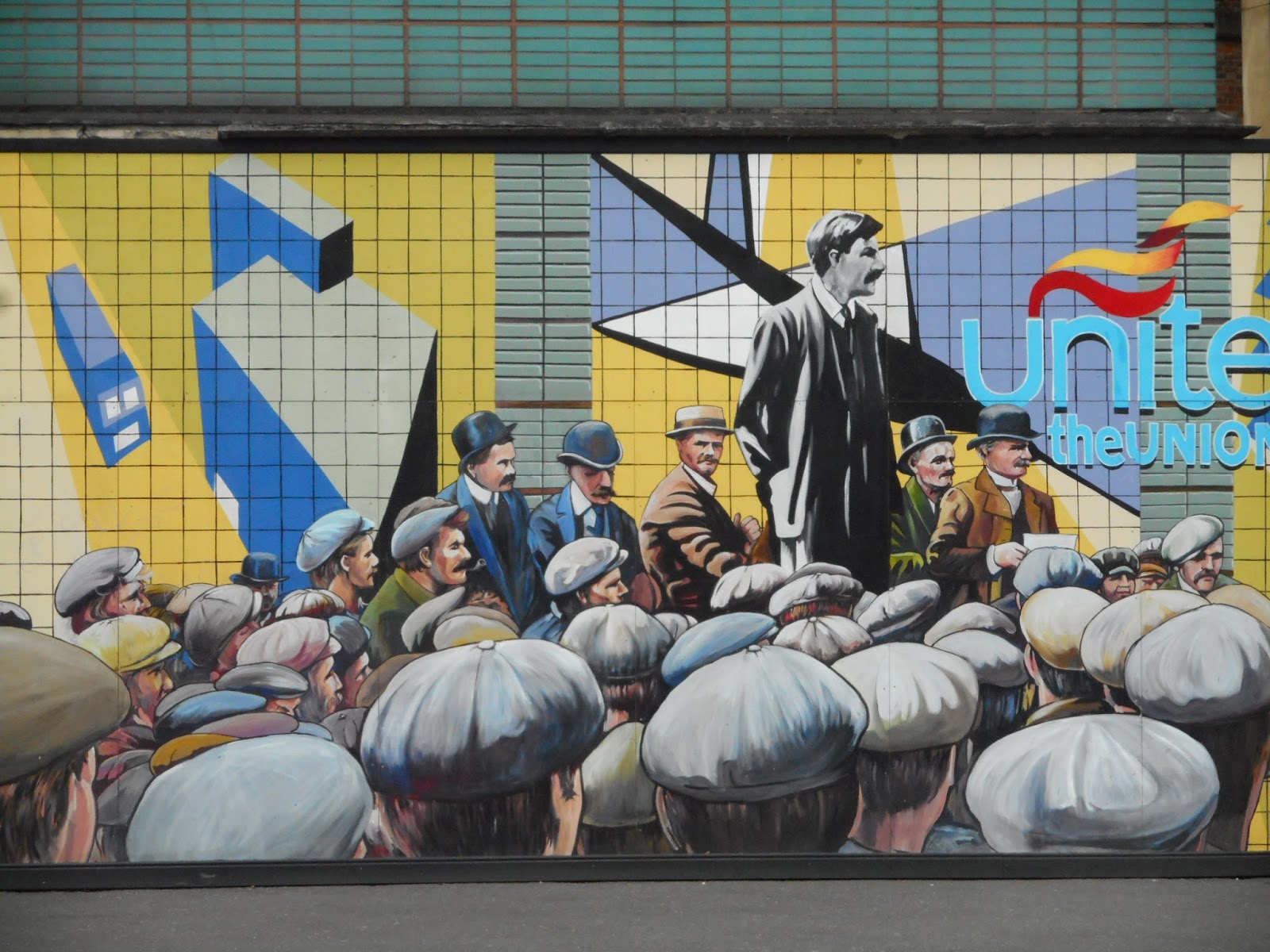
And this caught my eye - Transport House, the building that used to house the Transport and General Workers Union, has always had a distinctive mosaic mural themed on the industrial heritage of Belfast, facing onto High Street. It seems to have had some new murals added to it, to tie in with Unite moving back into the building, and in the same style - I think they look brilliant, so had to share!



Chris

For details on my genealogy guide books, including my recently released Discover Irish Land Records and Down and Out in Scotland: Researching Ancestral Crisis, please visit http://britishgenes.blogspot.co.uk/p/my-books.html.

Wednesday, 15 April 2015

New Lanark Mill Visitor Books transcription

Glasgow University Archive Services has an interesting post about a project to transcribe the names recorded in its New Lanark Mills visitors books.

The full story is at https://universityofglasgowlibrary.wordpress.com/2015/04/14/monthly-collections-blog-post-transcribing-the-new-lanark-mill-visitor-books/

Chris

For details on my latest book Down and Out in Scotland: Researching Ancestral Crisis, and my other genealogy guide books please visit http://britishgenes.blogspot.co.uk/p/my-books.html. To commission me for genealogical research, please visit my research site at www.scotlandsgreateststory.co.uk.

Monday, 13 April 2015

PRONI lunchtime lectures - The Antrim Coast in the Age of Industry

This looks like being a cracking series of lunchtime talks at PRONI (www.proni.gov.uk):

LUNCHTIME LECTURE SERIES: The Antrim Coast in the Age of Industry, 1750 to 1890.
When: Tuesday lunchtimes from the 28th April to 2nd June 2015
Where: PRONI

PRONI will be delivering a series of lunchtime lectures in April, May and June 2015 examining the arrival of Victorian technology and industrial activity in the Antrim coast and Glens. Until the 1800s much of the Antrim coast and Glens was wild and hard to access. During the nineteenth century the landscape was opened up and efforts were made to bring about an industrial revolution, like that of Belfast, in the country villages and peat-bogs.

Tuesday 28th April: The Industrial Heritage of the Antrim Glens, Fred Hamond

Tuesday 5th May: The Limestone Town of Glenarm: quarries and quarrymen, Gerard Muldoon

Thursday 21st May: The Ballintoy Project: how to organise a Local History Group, Robert Corbett

Tuesday 26th May: William Bald and the Making of the Antrim Coast Road, 1832 to 1840, Desmond McCabe

Tuesday 2nd June: Iron and Stone: the Earls of Antrim as Victorian industrialists, Ian Montgomery

(With thanks to the PRONI Express)

Chris

For details on my latest book Down and Out in Scotland: Researching Ancestral Crisis, and my other genealogy guide books please visit http://britishgenes.blogspot.co.uk/p/my-books.html. To commission me for genealogical research, please visit my research site at www.scotlandsgreateststory.co.uk.

Wednesday, 5 November 2014

Remember the Mills? event in Paisley

This looks a great event!

Remember the Mills?
Paisley Central Library on Friday 28 November 2014, at 2pm.

Do you remember Paisley's thread mills?

The Heritage Centre in Paisley Central Library are celebrating Book Week Scotland with a 'Remember the Mills?' event on Friday 28 November 2014, at 2pm.

Come along and share your memories of Paisley Mills. Did you work in the mills? You don’t need to have worked in the mills. You may have memories of getting caught in the rush of workers leaving at the end of the day shift or a friend or relative’s account of working there. You may have worked in the dye works or as an engineer. Whatever your experience join us in sharing your mill memories.

Paisley Thread Mill Museum are working in partnership with us for this event and will be bringing along some thread related exhibits as well as their knowledge of the mills. It should be an enjoyable, relaxed and hopefully fun event. The Heritage Centre are also planning to record these memories to help preserve them for future research and interest.

To secure a free place at this event or for more information please contact -

Heritage Centre, Paisley Central Library
Tel: 0300 300 1188
Email: heritage@renfrewshire.gov.uk

Please feel free to pass this email to members of your local historical societies, colleagues or friends and family who you think may be interested in this event.

(With thanks to Jack Davis, courtesy of the Scottish Genealogy Network's LinkedIn group)

Chris

My next Scotland 1750-1850: Beyond the Old Parish Records online course starts on November 5th, and runs for 5 weeks, priced at £45.99. Spaces are still available - see http://pharostutors.com/coursedescriptions.php#302

Wednesday, 2 October 2013

Cotton Town website updated

The Cotton Town website, which provides a digital archive of local history for Blackburn and Darwen in Lancashire, and specifically the textiles industries there based on cotton, has been updated. The site is accessible at http://www.cottontown.org.

Oh, and it's brilliant!

(With thanks to @LFHHSOnline)

Chris

My latest book, Discover Scottish Civil Registration Records, is now available from http://www.gould.com.au (print) and http://www.gen-ebooks.com/unlock-the-past.html (ebook), whilst Tracing Your Irish Family History on the Internet is available at http://www.pen-and-sword.co.uk/Tracing-Your-Irish-History-on-the-Internet/p/3889/. My next Pharos Scottish course, Scotland 1750-1850: Beyond the OPRs, starts Nov 13th - see http://pharostutors.com.

Friday, 4 May 2012

UK's industrial heritage under threat

From the Institute of Mechanical Engineers:

UK’s industrial heritage under threat

In 20 years almost half of the nation’s industrial artefacts and sites could stop working or be forced to close due to lack of skills

3 May 2012

The UK’s industrial heritage is under threat as traditional skills to maintain and operate these artefacts are being lost, according to a new policy statement from the Institution of Mechanical Engineers.

Chairman of the Institution of Mechanical Engineers’ Engineering Heritage Committee John Wood said:

“The UK’s industrial heritage is often overlooked, but these artefacts are not just revealing physical links to our great industrial history – from the Industrial Revolution through to the present day - but potentially profitable projects that can generate wealth and jobs to local areas.

“The country’s industrial heritage is now under serious threat. The majority of these artefacts are maintained and operated by a voluntary and a largely ageing workforce with scarce resources.

“This means there are limited resources to transfer skills as well as to meet increasingly stringent health and safety legislation.

“We need to take action now to help transfer skills, so that vital techniques and practices to maintain these precious links to our industrial history aren’t lost forever.”

According to the policy statement in about 20 years about half of the nation’s industrial artefacts and sites may stop working or be forced to close due to lack of key skills needed to maintain them.

In 2010 the British heritage sector, including the country’s industrial heritage, contributed over £7.4 billion to the economy and provided more than 190,000 full-time jobs.

The Institution’s ‘Saving Britain’s Industrial Heritage’ policy statement recommends that:
  • The industrial heritage sector works together to share best practice. The Institution of Mechanical Engineers would be willing, as an intermediary, to facilitate in the connectivity between societies, either in general or by specialism or issue if requested.
  • National organisations act to provide advice and guidance to all industrial heritage societies on how to maintain and preserve artefacts/sites and establish best-practice guidelines. It is in the national interest that these artefacts and sites are maintained, and these organisations are best placed to help establish core values.
  • The Department of Culture Media and Sport encourages the relevant national bodies to recognise the importance and potential value of the nation’s industrial heritage.
  • The Institution’s membership, where possible, be encouraged to help in the preservation and maintenance of industrial heritage artefacts and sites. The academic and engineering industrial knowledge of the Institution’s 100,000 members is a valuable asset which could assist local organisations in preserving industrial heritage for the future.

To read the full policy statement visit www.imeche.org/knowledge/policy/education/policy/IndustrialHeritage

(With thanks to the IME)

Chris

British GENES on Facebook at www.facebook.com/BritishGENES and Twitter @chrismpaton

Tuesday, 31 January 2012

Upper Clyde Shipbuilding Work-in screenings

From the University of Glasgow Library:

To celebrate the 40th anniversary of the Upper Clyde Shipbuilding Work-in, The Mitchell Theatre in Glasgow is screening a series of films that were made at the time. The UCS Work-in lasted for fifteen months during 1971/2 and represented a desperate struggle for the Trade Unions and Shipyard workers, who were facing mass redundancy if the government did not subsidise the industry.

The screenings will take place from Wednesday 21st March to Friday 23rd March 2012.

For further details visit http://universityofglasgowlibrary.wordpress.com/2012/01/30/ucs-film-screening-at-the-mitchell-theatre-glasgow/

Chris